
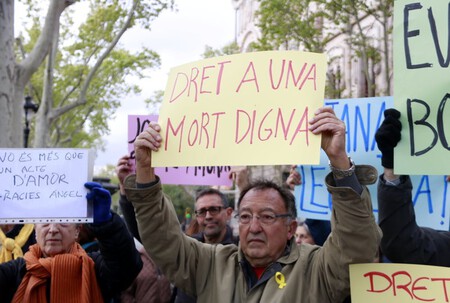
Noelia Castillo: A Judicial Labyrinth
Today marks a significant and somber moment in Spain as Noelia Castillo, a 25-year-old woman, prepares to undergo euthanasia in Catalonia. Unlike the thousands of other cases handled under the Euthanasia Law, her story has garnered unprecedented public attention, largely due to a protracted judicial battle that has lasted over 600 days.
A Complex Journey Through the Courts
Noelia’s case began when she requested assisted suicide, navigating a legal maze that included multiple courts—from local to European levels. Initially slated for euthanasia on August 2, 2025, her father intervened, enlisting the help of the ultra-conservative group ‘Abogados Cristianos’ to halt the process. This intervention sparked legal controversies that captivated media attention across Spain.
As of March 2026, Noelia is set to finally achieve her will after the European Court of Human Rights deemed there were no valid reasons to impede her request. This decision not only highlights her individual struggles but also ignites broader discussions on the ethical dimensions of euthanasia.
The Personal Struggles Behind the Headlines
Noelia’s plight is not just legal; it is deeply personal. She suffers from borderline personality disorder, a condition that has led her to experience severe distress and chronic pain. These mental health challenges compounded her physical limitations after a suicide attempt that resulted in paraplegia.
Despite expert evaluations confirming her condition and its non-recoverable nature, the crux of the debate remains whether Noelia is in a sound state to make such a profound decision. Her father’s opposition, rooted in love yet complicated by dogma, adds another layer of tension to an already intricate scenario.
Public and Media Reaction
The media has been relentless in portraying Noelia as a pivotal figure in the ongoing discussion about euthanasia in Spain. Unlike the majority of cases in which elderly patients with terminal illnesses seek assisted death, Noelia stands out as a young, mentally ill individual. Statistics reveal that over 75% of euthanasia procedures in Spain are performed on people older than 60, making her case particularly noteworthy.
Broader Implications
This situation extends far beyond Noelia Castillo. The ongoing discourse surrounding her case touches on issues of autonomy, mental health, and ethical treatment in end-of-life scenarios. Since the Euthanasia Law’s implementation, over 1,000 individuals have sought assisted dying in Spain, but none have captured attention quite like Noelia.
The controversy surrounding her father’s efforts to delay her euthanasia has stirred public discourse, drawing in various political and religious entities, thereby fracturing opinion on the matter. Advocates for euthanasia see Noelia’s case as crucial for illustrating the complexities surrounding assisted dying, particularly when it intersects with mental health issues.
A Future Uncertain
As the day of reckoning approaches, discussions about Noelia’s case are likely to proliferate. Whether it’s through public debates, policy changes, or shifts in public perception, Noelia Castillo will forever be a symbol in the evolving narrative of euthanasia rights in Spain.
The broader implications of her situation will continue to spark debates on dignity, choice, and the efficacy of current laws, ensuring her story resonates long after her last decisions are made.