
Pedro Almodóvar: The Hidden Presence of His Father in His Films
An Insight into Almodóvar’s ‘Bitter Christmas’
Pedro Almodóvar has been in the spotlight recently with the release of his latest film, Bitter Christmas. The film embraces the theme of ‘autofiction,’ interweaving the lines between reality and fiction. The character Raúl, portrayed by Leonardo Sbaraglia, serves as a kind of ‘alter-ego’ for Almodóvar himself. He is a film director navigating a creative crisis in search of inspiration, reflecting the director’s own personal journey, albeit one he claims not to have experienced directly.
The Complexity of Personal Narratives
In an engaging conversation with Infobae, Almodóvar elaborated on the intricate interplay between his real-life experiences and his cinematic work. He remarked, “It is true that since Pain and Glory I have turned to myself a lot, although, in reality, my entire life runs through my filmography.” Yet, he pointed out a striking absence: while his mother’s influence is omnipresent in his films, his father, Antonio Almodóvar, remains unrepresented.
“Many things about him are hidden within my female characters,” he confessed.
Uncovering Paternal Influences through Female Characters
Almodóvar has quietly embodied aspects of his father in female roles throughout his filmography. One poignant example is the character Victoria Abril in Tie Me Up! where she encounters a man carrying a donkey. In this scene, her character prescribes a plaster for the animal’s ailment, a nod to a skill his father possessed in caring for sick animals despite not having formal education. “In some way, I was paying homage to my father,” Almodóvar remarked.
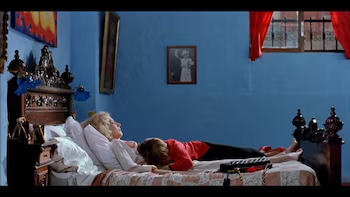
Another instance can be found in High Heels, represented by the character of Becky del Páramo, played by Marisa Paredes. In a memorable scene, she buys the house in which she was born, mirroring an experience of Almodóvar’s own father. When Antonio was seriously ill, he returned to his hometown after decades and was laid to rest in the same bed he was born in—an experience that deeply resonated with Almodóvar.
The Maternal Presence and Its Contrast
While Almodóvar frequently includes traces of his mother, Francisca Caballero, in his films, the absence of his father’s figure seems more starkly felt. Despite his father’s passing when Pedro was very young, the filmmaker now acknowledges the subtle ways in which his family legacy permeates his narratives. The father figure, initially hidden, becomes a meaningful subtext through the lives of his female characters.
Conclusion: The Legacy of Family in Almodóvar’s Works
Ultimately, Almodóvar’s exploration of familial ties—especially the subtle paternal influence woven through his female characters—illustrates the complexity of identity in his storytelling. Both Bitter Christmas and his previous films affirm that while he may not depict his father directly, the essence of Antonio Almodóvar lives on in the layers of his cinematic universe. Through this nuanced representation, Pedro Almodóvar continues to deliver rich, emotionally resonant narratives that honor his roots in profound and unexpected ways.