
The Interoceanic Corridor: A Game-Changer for Trade
If you’re looking to traverse from the Atlantic to the Pacific, the Panama Canal has long been the primary option, despite its challenges. However, emerging infrastructure projects like the Interoceanic Corridor of the Isthmus of Tehuantepec (CIIT) propose a transformative approach to interoceanic connectivity, promising to connect the two oceans in under seven hours.
The Concept of a “Dry Canal”
The CIIT is not a traditional channel but rather a multimodal infrastructure project that integrates railways and ports. Spanning over 1,200 kilometers of railway lines, the corridor connects two key ports: Coatzacoalcos on the Atlantic and Salina Cruz on the Pacific. This setup allows containers to be unloaded, transported via train across the isthmus, and then reloaded for their next journey—all in a swift timeframe of less than seven hours. The ambitious goal is to facilitate the movement of 1.4 million containers per year.
Importance of the Corridor
The Mexican government emphasizes the significance of the CIIT for several reasons:
- Economic Development: Enhanced rail and port infrastructure will boost trade efficiency.
- Competitiveness: It aims to serve as a viable alternative to the Panama Canal, especially for larger vessels that don’t fit in the canal’s locks.
- Nearshoring: In light of shifting global dynamics, the corridor offers an excellent opportunity for businesses seeking to minimize their reliance on distant markets like China.
Moreover, the corridor weaves through 79 municipalities, supporting local economies in Veracruz and Oaxaca.
Infrastructure Breakdown
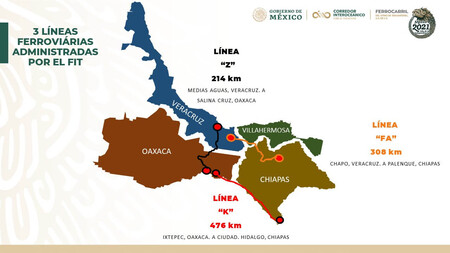
The CIIT’s railway system comprises three main lines:
- Line Z: Coatzacoalcos to Salina Cruz (214 km)
- Line FA: Coatzacoalcos to Palenque (308 km)
- Line K: Ixtepec to Ciudad Hidalgo (476 km)
Complementing the main ports, Dos Bocas and Puerto Chiapas play key roles. The project also includes the construction of 14 industrial parks, fostering industrial growth along the route.
Progress and Roadmap
The Mexican government plans to implement the CIIT between 2025 and 2030. Some railway lines are already operational, while others are projected to finish by mid-2026. Furthermore, ports will be modernized to handle larger vessels, aiming for full operational capability by that same year.
Challenges Ahead
While potential benefits are significant, the success of the CIIT hinges on its components functioning together efficiently. Currently, ports and railways progress at different rates, causing operational mismatches.
Moreover, the road ahead isn’t without hurdles. Current cargo transport numbers lag behind expectations, with only 111,000 tons of agricultural and 1,000 tons of industrial cargo moved in 2024. Additionally, the need for multiple handling steps complicates logistics compared to direct transfers seen in the Panama Canal.
Environmental and Security Concerns
The project also poses environmental risks such as deforestation, threats to endangered species, and water stress from industrial activity. Coupled with concerns over security and a shortage of skilled labor, these factors could hinder the corridor’s real impact in Mexico.
Conclusion
The Interoceanic Corridor of the Isthmus of Tehuantepec represents a bold move in reshaping trade routes. If successful, it could significantly change the logistics landscape in North America, providing a critical link between the Pacific and Atlantic while fostering economic growth throughout the region. However, its realization depends on overcoming current operational and environmental challenges.