
Cuban Regime’s Stance on U.S. Relations
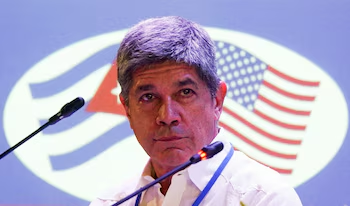
The Cuban government has unequivocally rejected any modifications to its political system at the behest of the United States. This declaration follows a controversial statement from former President Donald Trump, who mentioned that he would relish the opportunity to “liberate Cuba.” The Cuban Vice Minister of Foreign Affairs, Carlos Fernández de Cossio, emphasized that Cuba’s political structure is non-negotiable, affirming, “neither the president nor any official’s position in Cuba is subject to negotiation with the United States.”
Conditional Agreements and Regional Cooperation
While Fernández de Cossio remains firm on Cuba’s sovereignty, he acknowledged the potential for mutually beneficial agreements. He referred to previous instances where both nations have cooperated on issues such as national security and drug trafficking. In light of ongoing humanitarian crises affecting both countries, the Cuban government sees room for dialogue without fundamentally altering its political ideology.
Long-standing U.S.-Cuba Tensions
Fernández de Cossio lamented the “aggressiveness” and “ruthlessness” demonstrated by the U.S. towards Cuba, citing nearly seven decades of hostility that adversely impacts the everyday lives of Cuban citizens. Despite these tensions, he asserted that Cuba does not position itself as an enemy to the United States, nor does it intend to pose any threat to its northern neighbor.
Recent U.S. Remarks and Their Implications
Following Trump’s assertions of potentially “taking” Cuba, he described the island as a “failed nation” that is “very weakened.” Such comments come on the heels of severe operational challenges affecting Cuba, including a total blackout and ongoing energy shortages. These crises have been blamed on U.S. sanctions, which recently became more stringent.
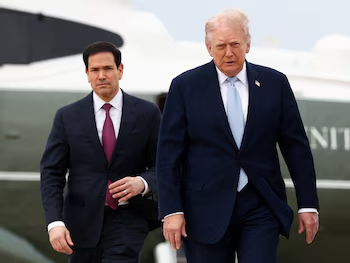
U.S. Secretary of State Marco Rubio has echoed Trump’s sentiments, labeling the Cuban government as a “disaster.” He reiterated that the current regime’s policies have not succeeded, emphasizing a dire need for change.
No Immediate Call for Resignation
Despite current tensions, U.S. officials, including Rubio, have clarified that the Trump administration has not demanded the immediate resignation of President Miguel Díaz-Canel. They have also indicated that U.S. military intervention is not on the table unless a direct threat to American interests arises.
Crisis and Energy Blockages
Cuba is currently experiencing one of its most severe electrical crises since the revolution led by Fidel Castro. A complete disconnection of the national grid left the island without power, exacerbating the already critical situation. With decreasing oil supplies, primarily due to reduced imports from Venezuela, Cuba faces daunting challenges in meeting its energy needs.
This unfolding energy crisis highlights the precarious nature of Cuba’s reliance on external resources and the complex interplay of U.S. sanctions and domestic policies.
(With information from Europa Press)