
The Camisea Gas Pipeline Incident: Evaluating Force Majeure Claims
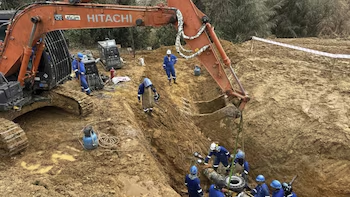
The investigation into the recent deflagration on the Camisea gas transportation system is at a critical juncture. The key question is whether the event can be classified as a “Force Majeure”. The regulator, Osinergmin, is closely monitoring the incident that took place at kilometer 43 in the Megantoni district of Cusco. Meanwhile, Transportadora de Gas del Perú (TGP) has formally requested that the incident be recognized as a “force majeure” event.
Implications of Force Majeure Classification
The determination of this evaluation will significantly impact the establishment of liabilities. If labeled as Force Majeure, TGP may be fully or partially exempt from administrative sanctions. Conversely, failing to meet this designation could initiate sanctions if non-compliance with technical or safety regulations is evidenced.
TGP argues that the rupture represents an “unforeseeable, extraordinary, and irresistible event” and must submit a supporting Force Majeure Event Report by March 20. This request aligns with concurrent expert analyses aimed at identifying the root cause of the incident, which disrupted the supply of natural gas and LPG in Lima, Callao, and Ica.
The Evaluation Process
Osinergmin is currently reviewing both the circumstances leading to the event and any resulting variations in service conditions. This examination adheres to Board of Directors Resolution No. 255-2021-OS/CD, which regulates these types of incidents.
Support for the Request
TGP has a deadline until March 20 to support its request, with the option of seeking an extension of 15 business days, subject to regulatory approval. Meanwhile, Osinergmin is tasked with verifying if the incident meets the criteria for Force Majeure.
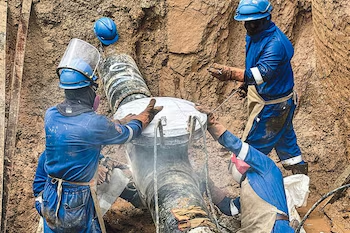
During the emergency response, agency supervisors have conducted field procedures, including personnel interviews and record reviews, to ascertain the cause of the incident and potential regulatory infringements.
Understanding Force Majeure
Force Majeure encompasses unforeseen events outside a company’s control that impede its obligations. This may include natural disasters, proven sabotage, or unavoidable extraordinary events. However, the regulator assesses whether TGP took appropriate preventive measures and if the incident was foreseeable.
To determine the applicability of force majeure, Osinergmin evaluates the event’s origin, predictability, company control, and previous compliance with maintenance and integrity obligations. Even natural phenomena may not qualify for Force Majeure if inadequate preventive actions were taken. A notable precedent occurred in 2006, when the company faced consequences for failing to implement necessary protective measures.
In 2025, the regulator performed 97 inspections of TGP’s infrastructure, focusing on aspects such as corrosion, ground stability, and damage prevention. In the specific case of the KPI 43 facilities—where the incident occurred—inspections during April and August showed no concerns.
Conclusion
As the situation develops, the evaluation of whether the Camisea gas pipeline rupture can be classified as ¡Force Majeure¡ will have significant repercussions for TGP. This incident serves as a crucial reminder of the responsibilities associated with infrastructure management and the obligations that operators hold to prevent future incidents.