
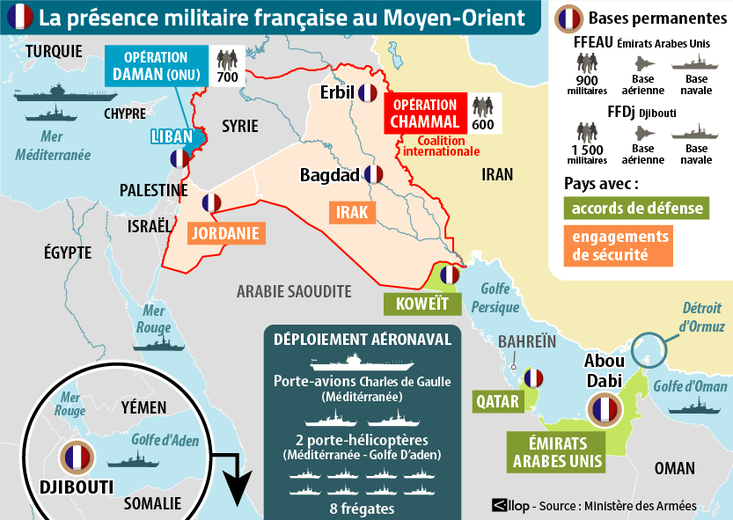
French chief warrant officer Arnaud Frion was killed by an Iranian drone in the Erbil region, Iraq, on the night of March 12 to 13, announced Emmanuel Macron. This incident underscores the complexities and dangers surrounding France’s military presence in the Middle East. Below, we explore the extent and locations of French military forces in this volatile region.
The French Presence in the Middle East
France’s military involvement in the Middle East dates back to 2014 when it joined the international operation Chammal, aimed at combating the rise of Daesh (ISIS) in Iraq and Syria. This mission highlights France’s commitment to stability and security in the region. The country maintains a multifaceted military presence across several key locations.
Iraq and Syria
In Iraq, the French forces provide crucial support to local troops engaged in the fight against Daesh. The recent loss of chief warrant officer Arnaud Frion serves as a stark reminder of the ongoing risks faced by French personnel in the region. France’s involvement also includes aerial operations aimed at conducting surveillance and targeting terrorist positions, thereby aiding local forces in their combat efforts.
Lebanon
In Lebanon, France contributes to the UN Interim Force (UNIFIL), where approximately 700 French soldiers are stationed. Their primary role is to assist in maintaining peace and security in southern Lebanon, especially along the Israeli border, amid ongoing tensions in the region. The presence of these troops underscores France’s commitment to regional stability and its historical ties to Lebanon.
United Arab Emirates and Djibouti
The French military also operates two permanent bases—both naval and air—in the United Arab Emirates and Djibouti, a strategically located country in the Horn of Africa. These bases serve as logistical hubs for operations across the region, facilitating rapid deployments and providing essential support for ongoing missions.
Qatar and Kuwait
Furthermore, France has established defense agreements with Qatar and Kuwait. In these countries, a small contingent of French officers is stationed to enhance military cooperation and training. These partnerships not only strengthen France’s military ties in the Gulf but also contribute to collective security efforts in a region marked by instability.
Naval Forces
In response to heightened tensions in the region, France has deployed significant naval assets, including the aircraft carrier Charles de Gaulle, two helicopter carriers, and eight frigates. This naval presence aims to bolster security in strategic waterways and projects France’s military power in the Mediterranean and beyond.
Conclusion
The recent attack resulting in the death of chief warrant officer Arnaud Frion highlights the challenges and dangers faced by French military personnel operating in the Middle East. France’s military footprint in the region reflects its strategic priorities and commitments to international security, fostering stability in a complex geopolitical landscape.