
The Changing Landscape of Yanbu
The landscape off the coast of Yanbu on the Red Sea has transformed dramatically. A fleet of Very Large Crude Carriers (VLCCs), colossal supertankers capable of carrying two million barrels of crude oil, has amassed in the area. This formidable concentration of ships is not just a transient occurrence; it signifies an unprecedented and urgent evacuation of oil.
A Fleet to the Rescue of the Market
A look at the figures presented by Financial Times reveals the magnitude of this rescue operation. Approximately 30 VLCCs are maneuvering towards Yanbu, a stark contrast to the typical two that arrive monthly. This unusual increase is due to the traffic in the Persian Gulf reaching a “stalemate” following Iranian attacks.
According to maritime tracking data from Bloomberg, the urgency is palpable. Within just 48 hours, at least 25 tankers have departed for the Saudi port, with a cumulative capacity to load around 50 million barrels. This makes Yanbu an essential escape valve as current blockades have already caused global oil production to tumble by 6%, prompting neighboring countries like Iraq and Kuwait to wind down operations due to storage limitations.
The Sea Bridge to Avoid Iran
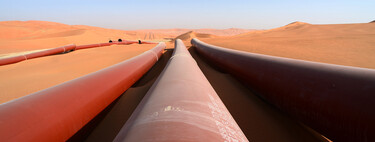
But how are these ships loading oil without entering the Gulf? The answer lies in Saudi Arabia’s 1,200-kilometer East-West pipeline, which serves as a conduit for crude oil transported overland to Yanbu. Here, an “army” of supertankers awaits, ready to distribute this oil worldwide, particularly to emerging markets like China and India.
Infrastructure in High Demand
As noted by the Wall Street Journal, this pipeline has overnight become “one of the most critical pieces of the world economy.” Saudi Aramco’s CEO, Amin Nasser, confirmed that the pipeline is nearing its maximum capacity, facilitating 7 million barrels per day, of which 5 million are aimed for supertankers.
The Risks Ahead
However, sailing to Yanbu is fraught with danger. According to the Financial Times, these ships must navigate through areas known for Houthi attacks. The Bab al-Mandab Strait, crucial for their journey to Asia, poses an enormous risk, remaining vulnerable to Iranian missile strikes.
Even the port of Fujairah in the UAE, another potential escape route, has suffered damage from recent drone attacks, indicating that while alternatives to Hormuz may be less perilous, they are not without their risks.
Limits of the Current Plan
The pressing question is whether this armada of ships and desert pipelines can stave off economic collapse. The closure of the Strait of Hormuz has removed 20 million barrels per day from the global supply, and there are inherent limitations to the alternative route. Although the Saudi pipeline can transport up to 7 million barrels, Yanbu’s terminals can only load 4 to 4.5 million per day, leading to inevitable queues of waiting supertankers.
Moreover, the looming distillate crisis complicates matters further. Experts from Middle East Eye highlight that the East-West pipeline carries crude oil but not refined products essential for markets, particularly in Europe, which depend on diesel and aviation fuel from the inaccessible refineries of the Middle East.
Geopolitical Implications
Amidst these developments, U.S. strategic priorities remain clear. President Donald Trump has reaffirmed that countering Iran is paramount, even more so than gasoline prices. As the U.S. is a large oil producer, it may withstand price increases better than other nations.
Meanwhile, the International Energy Agency’s release of strategic reserves aims to buy time. However, as analyst Javier Blas notes, this does not substitute for a reopened Strait of Hormuz.