
The Mistake That Alpine Made and Hurt Colapinto in Australia
The debut of Argentine driver Franco Colapinto in the Australian Grand Prix was overshadowed by a stop-and-go penalty that significantly impacted his performance. This sanction, arising from an operational error by the Alpine team, generated further commentary from both Colapinto and general director Steve Nielsen, who accepted responsibility and explained how the mistake occurred.
The Incident at Albert Park
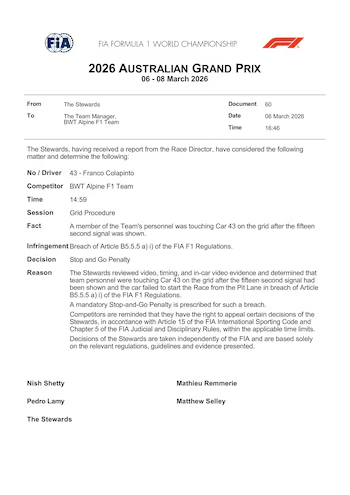
Colapinto’s day started off on the wrong foot even before the race commenced on the Albert Park Circuit. During the formation lap, an Alpine mechanic inadvertently touched car number 43—a move that is prohibited under the regulations as it was less than 15 seconds from the start. This mistake, initially unnoticed by the team, was spotted by FIA sports stewards, who enforced the penalty outlined in Article B5.5.5 a) i) of the Formula 1 Sports Regulations.
According to the regulations, “If any member of the team personnel is touching an F1 car or if team equipment is connected to an F1 car on the grid after the fifteen-second signal has been displayed, the driver of the F1 car in question must start from the pit lane. A Stop-and-Go penalty will be imposed on any driver who does not start from the pit lane.”
Consequences of the Penalty
Due to the imposed penalty, Colapinto had to serve a stop-and-go in the opening phase of the race, dropping from fifteenth to twentieth position and significantly hampering his chances of earning points in his debut. Official reports stated that video evidence, timing data, and onboard images were reviewed, confirming that team personnel touched car 43 after the fifteen-second signal had been displayed—a clear violation of regulations.
Colapinto’s Reaction
After the race, Colapinto expressed his disappointment but remained optimistic about the future. “Based solely on the result, we are not where we wanted to be; however, there are positives to take from our race pace and the data collected,” he stated. He further noted, “We win and lose as a team, and we are in this together,” highlighting the camaraderie within the team despite the challenging circumstances. Colapinto also recounted a near-miss during the start of the race, nearly colliding with another driver, which further complicated an already difficult situation.
In addressing the penalty, he acknowledged understanding that the team’s premature intervention was the issue but emphasized the need for further communication with his crew.
Alpine’s Response and Accountability
Alpine’s response came swiftly, with Steve Nielsen accepting full responsibility for the error. “An operational error forced Franco to serve a penalty that ended any chance of scoring,” he lamented. Nielsen assured, “We can only apologize to Franco, as it was out of his control.” He elaborated on the nature of the violation, stating that the rule was longstanding and emphasized the learning opportunity it provided for the team.
Nielsen made it clear that the team would take corrective measures to prevent a repeat incident in the future: “We will learn from this, and it will not happen again.” He also defended Colapinto’s performance, noting that aside from the procedural error that led to the penalty, he did not believe the rookie had made any mistakes.
The Race Outcome
Ultimately, Colapinto finished the race in fourteenth place, two laps behind the leaders. The race was won by George Russell (Mercedes), who was followed by Kimi Antonelli and Charles Leclerc. The challenges faced by Colapinto at this pivotal debut point to both the pressures of F1 and the responsibilities of team management in ensuring optimal performance on the track.