
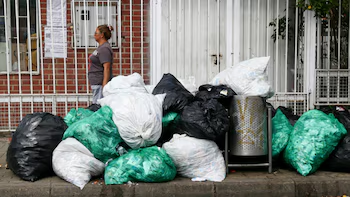
Garbage Crisis in Bogotá: A Deep Dive
Overview of the Crisis
Bogotá is currently grappling with a severe garbage crisis, marked by over 23,400 clandestine disposal points and 478 active critical areas. The city produces more than 6,600 tons of waste daily, a staggering volume that has strained its waste management systems to the breaking point.
Current Waste Management Challenges
The crisis reflects significantly in the alarming statistic of approximately 438,000 instances of illegal dumping reported annually in public spaces. Most of the city’s refuse is buried in the Doña Juana landfill, which currently handles over 80% of the waste generated by Bogotá’s residents. Unfortunately, only a mere 16% of this waste is repurposed or recycled, exposing the city’s lagging standards in comparison to global circular economy benchmarks.
Insights from Experts
In a recent discussion with Nelson Cubides, an expert in technological innovation, several strategies were proposed to tackle the growing problem. According to Cubides, the challenge is not just the quantity of waste generated, but also the inefficiency in leveraging this waste for recovery and recycling. “Our issue is how little we are taking advantage of what we produce,” he emphasized.
Administration’s Response and Actions
The district administration has responded by ramping up efforts to rectify the deteriorating public spaces. Initiatives such as the Cleaning Squad, which removed approximately 960 tons of waste daily from critical locations in 2025 and 2026, have been implemented. Moreover, 211 ecopoints have been established, and the “Cazaregueros” initiative aims to thwart illegal dumping.
Despite these actions, Cubides argues that the fundamental issue remains unresolved. The city must shift from a reactive maintenance model to one that envisions long-term transformation in waste management. He insists that Bogotá should pivot from merely burying waste to employing methods that promote energy recovery and mass utilization.
Need for a New Waste Management Model
To facilitate this shift, Cubides highlighted the importance of prioritizing waste separation at the source, formalizing roles for recyclers, and investing in advanced treatment technologies. The recent decision to extend waste management contracts until 2027 should be viewed as an opportunity to reshape public waste policies with a long-term perspective.
Cubides strongly argues that this extension must not simply serve as an administrative formality but should catalyze a comprehensive rethinking of urban waste management strategies. This transition is critical if Bogotá is to avoid perpetuating practices that lead to environmental and operational bottlenecks.
Conclusion: The Path Forward
Bogotá stands at a crossroads: it can either continue its current pattern of burying tons of waste daily or redefine waste as a valuable resource with both economic and environmental advantages. The urgent imperative is to move beyond the existing reactive management approach toward a more sustainable, proactive framework. Failure to act now could usher in a future crisis that jeopardizes not only public health but also the city’s overall livability and attractiveness for future generations.