
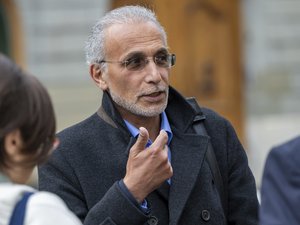
The Paris departmental criminal court has instated a significant ruling regarding Swiss Islamologist Tariq Ramadan, ordering him to stand trial in absentia and behind closed doors. This decision came on March 6, as an arrest warrant was issued for the absent 63-year-old accused. Ramadan’s absence stems from claims of health issues, a plea that was ultimately rejected by the court, which asserted there was “no valid excuse” for missing the proceedings.
## Court’s Ruling: Trial in Absentia
The presiding judge, Corinne Goetzmann, announced, “Tariq Ramadan will be judged in default.” Despite his defense team requesting a postponement for medical reasons, the court deemed the evidence insufficient to warrant such a delay. The ruling highlights the court’s commitment to proceeding with the case, despite Ramadan’s claim that a severe flare-up of his multiple sclerosis prevented him from attending.
Ramadan’s legal team exited the courtroom in protest, expressing that they could not accept what they termed a “parody of justice.” Their departure underscores the controversial atmosphere surrounding this trial and the tensions between Ramadan and the judicial system.
## Health Assessment and Rejection of Medical Claims
The controversy regarding Ramadan’s health escalated when medical experts appointed by the court assessed his condition. They concluded that his multiple sclerosis was stable and presented “no signs of recent flare-up.” Thus, they believed he was capable of attending court—a finding that directly contradicted the defense’s arguments.
In a last-ditch effort, Ramadan’s legal representatives provided a letter from his doctor, asserting that he required a rest period of one week to ten days. This claim was labeled by Advocate General Philippe Courroye as a “last dilatory joker,” accusing Ramadan of evasion tactics to avoid facing justice.
## The Charges Against Ramadan
Tariq Ramadan faces serious allegations of rape involving three women, with incidents purportedly occurring between 2009 and 2016 in Lyon and Paris. He has denied all charges, insisting that they are unfounded. Notably, he was previously convicted in Switzerland for a separate rape case, for which he received a significant prison sentence.
These allegations include accusations of aggravated rape involving violence and targeting a vulnerable person. One high-profile case connects him to Henda Ayari, a former Salafist, whose complaint in 2017 initiated the legal scrutiny against Ramadan.
## Implications of Closed Sessions
The court’s decision to conduct the trial behind closed doors adds another layer of complexity to this case. This procedural move came at the request of one of the civil parties. The implications of this closed session are profound, as it limits public access to the proceedings and raises questions regarding transparency.
Despite the defense’s claims that Ramadan desires to stand trial publicly, the reality of the court proceedings presents a starkly different scenario. The tensions between the defense and prosecution continue to escalate, as both sides argue over the legitimacy of the judicial process and the approach taken by the court.
## Conclusion: A Case Under Scrutiny
As this trial progresses, the legal, moral, and societal implications of Ramadan’s case remain under heavy scrutiny. Facing a potential twenty-year sentence if convicted, Ramadan’s future now hangs in the balance of a closed courtroom. The unfolding events are not only vital for those directly involved but also resonate within broader discussions about justice, health, and the complexities of high-profile cases in the public eye.