
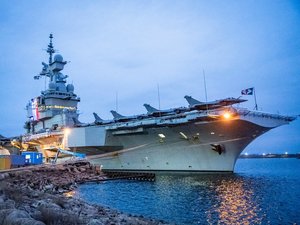
The nuclear aircraft carrier Charles-de-Gaulle has embarked on a mission from northern Europe to the Mediterranean Sea, as announced by French President Emmanuel Macron. This movement of the French naval powerhouse is occurring amidst escalating tensions in the Middle East, particularly related to the ongoing conflict in Iran. The flagship of the French Navy, with a complement of approximately 1,900 sailors and around 40 aircraft, aims to enhance France’s military presence and power projection capabilities in the region.
The Role of Charles-de-Gaulle
Commissioned in 2001, the Charles-de-Gaulle serves as a pivotal asset in France’s naval strategy. Recognized as the primary element of the naval air group, it is described as a “major vector of power projection and air-maritime space control missions,” according to the Ministry of the Armed Forces. As geopolitical tensions mount, the deployment of the Charles-de-Gaulle underscores France’s commitment to securing its interests and maintaining regional stability.
Strengthening French Military Presence
The announcement of this deployment is particularly strategic. The Charles-de-Gaulle and its “air assets and frigate escort” are heading to the Mediterranean, positioning France as a key player amid the unrest. Enhanced naval capabilities in this region allow not only for deterrence but also provide options for humanitarian assistance if necessary.
Impressive Specifications
The specifications of the Charles-de-Gaulle make it a formidable force. Measuring 261.5 meters in length and 64 meters in width, the aircraft carrier can navigate significant distances, traveling up to 1,000 kilometers per day at a speed of 27 knots. With a full load capacity of 42,500 tonnes, its operational efficiency is a critical asset in any conflict scenario.
Armament and Aircraft Capabilities
In terms of weaponry, the Charles-de-Gaulle is well-equipped. It houses steam catapults, two nuclear reactors for propulsion, machine guns, cannons, and advanced radars to monitor its surroundings. The carrier’s air group can include a mix of up to forty aircraft, such as Rafale jets and Hawkeye surveillance planes, enhancing its combat and reconnaissance capabilities.
Current Status and Future Insights
As of the latest updates, the Charles-de-Gaulle was still located in northern Europe. French Foreign Minister Jean-Noël Barrot indicated that, to the best of his knowledge, it is on a course toward the Mediterranean. Recent incidents have heightened awareness; notably, a Russian drone was intercepted near Malmö, Sweden, raising concerns about regional security as the carrier heads south with its important mission.
The movement of the Charles-de-Gaulle to the Mediterranean signifies a proactive stance by France, emphasizing the importance of maintaining a robust military presence in an increasingly volatile environment. This deployment not only showcases France’s military capabilities but also serves as a strategic maneuver aimed at achieving stability in a critical geopolitical landscape.