
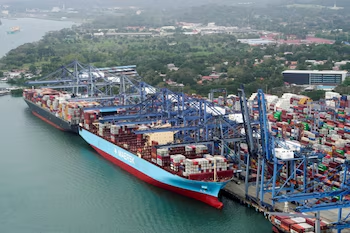
Panama Canal Authorities Monitor Middle East Crisis Impact on Maritime Trade
Current Situation
As tensions rise in the Middle East, specifically concerning maritime operations in the Strait of Hormuz, the Panama Canal authorities are on high alert. The canal, a vital artery for global trade, connects the Atlantic and Pacific Oceans and facilitates approximately 3% to 6% of world trade. Although officials deem it “premature” to predict specific impacts, they are closely observing the unfolding situation, particularly as 20% of the world’s oil and significant quantities of liquefied natural gas (LNG) traverse Hormuz.
Importance of the Strait of Hormuz
The Strait of Hormuz is a critical chokepoint, through which roughly 84% of crude oil and 83% of LNG transported via maritime routes passed in 2024. The Iranian Revolutionary Guard has fortified its stance, proclaiming the area “no longer safe” for maritime traffic. Consequently, the U.S. Department of Transportation has issued advisories for commercial ships to avoid the Persian Gulf and related waters.
Implications for Oil and Gas Markets
Recent geopolitical dynamics have compelled various Asia-Pacific shipping companies to reconsider their routes. The recent conflict escalation has led to route suspensions and reorganizations, raising significant concerns over energy supply chains.
Panama Canal’s Response
Amidst these challenges, Panama Canal authorities remain committed to maintaining a “safe, efficient, and reliable” service for maritime operations. They emphasize the importance of continual surveillance over international shipping dynamics to adapt as necessary.
The Geopolitical Landscape
Iran’s actions to restrict maritime movement follow military confrontations involving the United States and Israel, leading to increased regional tensions. Such developments have already initiated market reactions, indicating a rising concern among trading nations.
Navigational Challenges Ahead
The Strait of Hormuz, at its narrowest, spans only 34 kilometers with constrained navigable corridors. This limitation signifies that the majority of oil exported from countries like Saudi Arabia, Kuwait, and Qatar relies heavily on this route. With alternative paths insufficient to mitigate disruptions in Hormuz, a closure could redirect tankers to the Bab al-Mandeb Strait, a narrower channel at 29 kilometers wide.
Conclusion
The ongoing crisis in the Middle East poses potential threats to the fluidity of maritime trade, now more than ever. As threats to shipping safety escalate through the Strait of Hormuz, global reliance on the Panama Canal intensifies. Both the canal authorities and international commercial interests must remain vigilant to navigate these turbulent waters as geopolitics redefine shipping routes and energy logistics.