
The EU Calls for a Freer Iran After Khamenei’s Death: A Decisive Moment in History
A Turning Point for Iran
The European Union has described the death of Ayatollah Ali Khamenei as a “decisive moment” in Iran’s history. Khamenei was reportedly killed in a series of attacks orchestrated by the United States and Israel. This event has opened up discussions about a potential shift towards greater freedom for the Iranian people. European officials are now keen to explore the implications of this leadership vacuum.
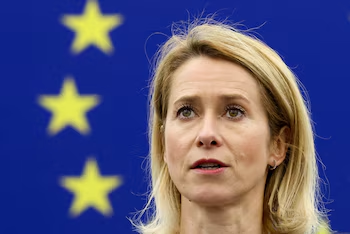
Kaja Kallas, the EU’s High Representative for Foreign Affairs, expressed optimism through social media, stating, “The death of Ali Khamenei is a defining moment in Iran’s history. What will come next is uncertain. But there is now an open path to a different Iran, one in which its people can have greater freedom to shape it.”
Necessity for Stability
Kallas emphasized the importance of stability in the region amid this uncertainty. She is in communication with regional partners who have faced consequences due to Iran’s military actions. The challenge now lies in finding practical measures to reduce tensions and prevent any escalation of violence.
Ursula von der Leyen, President of the European Commission, echoed these sentiments. She described the moment as one that could “rebirth hope for the Iranian people” and urged them to take control of their own future. “The future belongs to them,” she affirmed, highlighting the potential for change in Iran.
Risks of Instability
While there is hope for a brighter future for the Iranian populace, the transition could also give rise to instability that may spiral into violence. European leaders are aware of this risk and have voiced their commitment to safeguarding stability within the region.
Von der Leyen communicated her solidarity with the King of Jordan, Abdullah II, following the Iranian retaliatory attacks. The need for collaborative efforts to maintain security and protect civilian lives has become more pressing than ever. “Jordan is a valuable partner for Europe in the region and will play a key role in the period ahead,” she stated.
The Legacy of Khamenei
Ayatollah Ali Khamenei served as Iran’s Supreme Leader since 1989, succeeding Ayatollah Ruhollah Khomeini. His reign was characterized by a hard-line stance on international relations and conservative domestic policies. Criticisms arose regarding his repression of dissent and the enforcement of mandatory veiling for women.
Born in 1939 in Mashhad, Khamenei had solidified his political influence over the decades. He served as president from 1981 to 1989 and had previously held various governmental roles, including deputy defense minister and commander of the Revolutionary Guard.
Conclusion
The death of Khamenei marks a pivotal moment not only for Iran but also for the geopolitical landscape in the Middle East. As the European Union and regional partners contemplate the future, the collective hope is for a more liberated Iran. However, the path forward must be navigated with caution to ensure that the turbulence of change does not lead to further strife. The coming days and weeks will be crucial in determining the trajectory for the Iranian people and their governance.