
More than 40 Iranian Commanders Killed in Coordinated Attacks
The Israeli Army has announced a significant escalation in its operations against the Iranian regime. On Sunday, they reported that over 40 senior Iranian military and political leaders were killed during a series of coordinated attacks. This includes the shocking elimination of Supreme Leader Ali Khamenei, as confirmed by U.S. President Trump, who noted that a total of 48 leaders were targeted.
The Operation “Roar of the Lion”
Military spokesman Lt. Col. Nadav Shoshani described the initial phase of the operation, noting, “The first step of this operation was the initial attack in which we eliminated 40 senior commanders, including Khamenei, in one minute in two different locations more than a thousand miles from Israel in broad daylight.” This unprecedented military effort reflects a high-stakes strategy aimed at dismantling Iran’s command structure.
Key Iranian Leaders Targeted
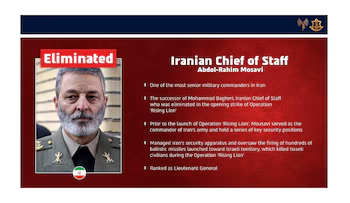
Among the key figures eliminated was Abdolrahim Mousavi, the chief of the General Staff of the Iranian Armed Forces. He was a pivotal player within Iran’s military apparatus, overseeing crucial operations, including the launch of ballistic missiles targeted at Israel. The Israeli Army described the action as a historic move that significantly weakens Iran’s military capabilities.
High-Level Casualties Confirmed
The operation, referred to as “Roar of the Lion,” specifically targeted high-ranking members of Iran’s security leadership. Reports indicate that in addition to Khamenei, other notable casualties included Gholamreza Rezaian, head of Iran’s police intelligence services, and Mohammad Pakpour, the commander of the Revolutionary Guard.
The Israeli military claimed responsibility for seven significant kills, marking this as a significant operational victory. The magnitude of the attack, which targeted multiple locations within Tehran, showcases an enhanced capability and intelligence depth that Israel has developed over time.
Strategic Implications
The elimination of these key figures represents not just a tactical victory for Israel, but a broader strategic setback for the Iranian regime. The Israeli Defense Forces (IDF) have stated that the aim is to dismantle the Iranian security apparatus and ensure long-term stability for Israel against potential threats.
Furthermore, the joint military efforts between the U.S. and Israel mark a noteworthy collaboration aimed at countering Iranian influence in the region. The surprise nature of the attacks has been emphasized by both nations, indicating a newly assertive stance on preemptive strikes.
Ongoing Operations and Future Outlook
Following the attacks, the IDF has reported ongoing operations aimed at neutralizing any remaining threats posed by the Iranian regime. The military aims to maintain air superiority over Tehran and will continue to monitor and engage any potential retaliatory actions by Iran.
As the situation unfolds, many analysts are observing the geopolitical ramifications of these attacks and how they will influence the balance of power in the Middle East. This military action could spur a re-evaluation of policy not just within Iran, but across the entire region as nations grapple with the implications of Israel’s decisive and lethal military strategy.
In conclusion, the recent attacks illustrate a new chapter in the longstanding conflict between Israel and Iran, highlighting the increasingly volatile nature of Middle Eastern geopolitics. As both nations react to these developments, the potential for further escalation remains high.