
Not all adventures have to be successfully resolved to become epic. One such tale is the Imperial Transantarctic Expedition, which left England in August 1914 under the leadership of explorer Ernest Shackleton. His ambitious goal was daunting: to cross Antarctica from Vahsel in the Weddell Sea to Ross Island on the opposite side.
Harsh conditions led to the ship Endurance becoming trapped in the ice, complicating Shackleton’s plans. This led to a feat that tested the endurance of Shackleton and his crew to an unimaginable level amidst icebergs, frigid temperatures, and extreme exhaustion. In the crucible of these struggles, he unwittingly coined the term “third man factor or syndrome”, a phenomenon well known to mountaineers even today.
“Who is the third person walking beside you?”
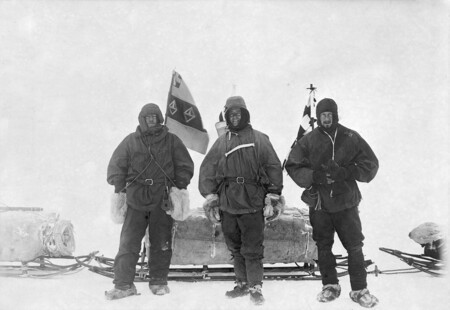
Ernest Shackleton (left) with Robert Falcon Scott and Edward Wilson in Antarctica, 1902.
The phenomenon was articulated by Shackleton as he recounted the grueling two and a half days spent advancing—alongside Frank Worsley and Tom Cream—towards a whaling station on the northern coast of South Georgia. They endured 36 consecutive hours of harrowing conditions, carrying not only their burdens but also the weight of rescuing the remaining companions from the doomed Imperial Transantarctic.
While only three ventured through the barren expanse of Antarctica, if surveyed, they would likely say there was another individual accompanying them—a fourth presence that was nameless and faceless yet palpable.
“I know that during that long and stormy march over nameless mountains and glaciers, it often seemed to me that there were four of us, not three,” Shackleton wrote. This sentiment, echoed in an article from the Guardian, highlighted a shared experience of an invisible companion.
This sensation intrigued the poet T. S. Eliot, who later referenced Shackleton’s idea in his poem The Waste Land in 1922: “Who is the third one who always walks by your side? When I count, there is only you and me together, but when I look ahead on the white road there is always another walking at your side.”
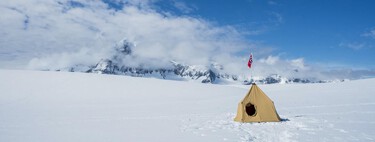
Eliot’s alteration of Shackleton’s “fourth” man to “third” was fitting, and since then we have often discussed the “third man syndrome”. It reflects the sensation of a ghostly companion—an entity that provides comfort during border experiences.
Shackleton wasn’t alone in his description. Years later, in 1933, Frank Smythe, another British explorer, recounted a similar experience during his ascent of Mount Everest. “The whole time I was climbing alone I had the strong feeling that I was accompanied by a second person. It was so strong that completely eliminated all the loneliness I might otherwise have felt,” he recorded in his diary.
The sensation was so vivid that, at one point, Smythe searched his pocket, pulled out a piece of Kendal Mint Cake, broke it in half, and extended one piece to this close companion.
Of course, he saw no one.
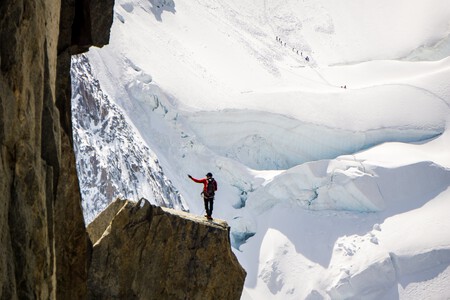
Not too long ago, the Madrid mountaineer Fernando Garrido documented a similar experience during his more than two-month stay atop the Aconcagua, aiming for an altitude survival record in 1986.
“Today, like on other occasions, I woke up sensing that there was someone outside next to the store. Have you spent the night there? Why didn’t he call me to let him in?” he recounted in statements collected by The Confidential. In his mind, he was convinced it was his deceased brother, Javier, exclaiming, “Javi, wake up, come on, wake up! I turn it towards me. “He is dead, his head is a skull.”
“A solid science”
Numerous articles have explored this intricate phenomenon, with sources ranging from the Guardian to NPR. In 2008, John Geiger dedicated a book to the subject, ‘The Third Man Factor: Surviving the Impossible’, after spending five years compiling similar accounts.
Yet, providing plausible scientific explanations for these experiences remains complex. During a discussion with NPR’s Guy Raz, Geiger indicated that while some attribute this syndrome to spiritual experiences, he contended it can be explained through “solid science.” Many skeptics and non-believers have had comparable encounters, attributing them to various other factors.
In 2009, Geiger suggested possible explanations such as biochemical reactions or disturbances in brain activity. “If we understand that the third man factor is part of us, like adrenaline… we can access it more easily. It is not a hallucination in the traditional sense; it serves as a very valuable and coherent guide,” he reflected.

Research by Ben Alderson-Day and David Smailes has highlighted that “strong feelings of presence” aren’t solely isolated to extreme situations; they can arise in varied circumstances, including after loss, during sleep paralysis, or with certain neurological disorders like Parkinson’s disease. “The varied contexts of these experiences might offer insights into their underlying mechanisms,” they suggest.
Understanding the intricacies of how and why these felt presences manifest may reveal aspects about ourselves: our reactions to intense mental or physical stress, our coping strategies under threat, and even how we perceive our bodily form.
Moreover, it can illuminate other extraordinary experiences that elude conventional understanding, as experts conclude. “The Third Man doesn’t just illustrate something about our minds or bodies; it can guide us in comprehending others, just as it did for Shackleton.”
As time progresses, the phenomenon remains ever more fascinating, drawing the attention of researchers who seek to understand not only the natural threats awaiting mountaineers but those lurking within their minds, including potential isolated altitude psychosis.
Images | Thibault Lam Tran, Mountainarious (Unsplash), Wikipedia/National Library of New Zealand and Inspire Toud (Unsplash)