
Municipalities with the Highest Rates in the Country
In a significant move towards tax transparency, the national government has launched a municipal tax transparency website aimed at combating excessive local rates. This initiative allows citizens to report municipal fees they deem irregular or excessive.
Overview of the Transparency Initiative
The new portal, aptly titled “Find out what you pay in fees,” features an interactive map encompassing 188 municipalities across 23 provinces (excluding the City of Buenos Aires). This tool is freely accessible without any prior registration. Initially, the information provided came from tax ordinances approved as of March 31, 2025, along with data collected from official municipal websites.
The government’s objective is to enhance local tax transparency and exert pressure on municipalities to lower their tax rates or potentially eliminate unnecessary fees.
Local Reactions and Political Pushback
The launch of the platform has ignited debates among local officials. Manuel Adorni, the Chief of Staff, announced the initiative on social media, which prompted a response from the mayor of Quilmes, Mayra Mendoza. She labeled the government’s actions as “nerve,” criticizing the national administration for neglecting its obligations to the Province of Buenos Aires.
In contrast, Lucas Ghi, the mayor of Morón, defended municipal charging practices, citing that municipalities do not collect taxes like the national and provincial governments. “The rates we impose are for services we provide,” he explained.
Breaking Down Municipal Rate Categories
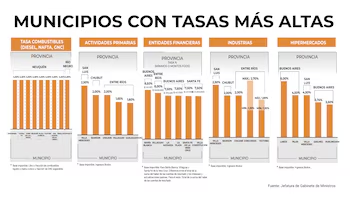
The collected data categorizes rates into five distinct areas: road rates, financial entities, primary activities, industry, and hypermarkets.
Road Taxes
Initially set to maintain local roadways, road taxes have now expanded to include fees at filling stations within municipalities. They vary widely, ranging from 0.80% to 4.5%. Notably, the municipalities with the highest rate of 4.5% include Neuquén capital, Plottier, and Cipolletti.
On the opposite end, Marcos Paz boasts the lowest rates at 0.80% for diesel and petrol.
Primary Activity Rates
For primary activities such as agriculture and livestock, Villa Mercedes leads with a rate of 2.5%. Following closely are Rawson and Chajari at 2%, with various municipalities adopting fixed percentages.
Financial Entity Rates
Among financial entities, Bahía Blanca stands out with the highest rate of 8.5%, although the imposed fixed amount remains comparatively low. Other municipalities, like Villaguay and Chajari, have similarly high percentages.
Industry Tax Overview
In the realm of industrial activity, Villa Mercedes again tops the list with 2.5%, alongside Rawson and Chajari both at 2%. Interestingly, Goya in Corrientes charges no tax on industrial activity.
Hypermarket Tax Insights
Finally, hypermarket taxation highlights Lanús as the municipality with the highest charge at 6%, followed by Pilar and Villa Mercedes, both contributing 4.5%.
Conclusion
This new tax transparency initiative underscores the government’s commitment to addressing municipal rates and unveiling district-specific taxation practices. As local governments respond to these transparency efforts, the future landscape of municipal taxation may change significantly, ideally leading to fairer rates for citizens.