
Why Is the Great Dyke of Zimbabwe Still Visible Today?
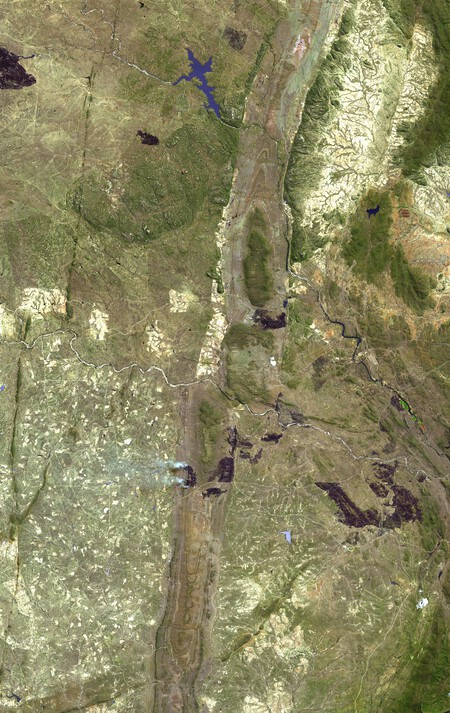
From an aerial view, the Earth reveals fascinating patterns and geological features. Among these is the remarkable Great Dyke of Zimbabwe, a geological marvel that can be distinguished from space. Its existence dates back an astonishing 2.5 billion years, earning it the title of the longest known continuous rock intrusion on the planet. Notably, it is not a dam, but a unique geological structure whose visibility persists through the ages.
A Geological Wonder
Stretching 550 kilometers and varying in width from 3 to 13 kilometers, the Great Dyke is a lopolito—a type of igneous rock formation. It juts up to 450 meters above the Zimbabwe Craton, making it not only a visual landmark but also a significant geological reference point observed from space.
NASA and other space agencies have captured the Great Dyke in images over the decades, demonstrating its distinctive form. Early photographs include an image taken in 1983 from the Space Shuttle Challenger, showing only part of the structure, and a more comprehensive view in 2000, courtesy of NASA’s ASTER satellite.
Historic Imagery from the International Space Station
One of the most iconic images of the Great Dyke was captured on September 30, 2010, by an astronaut aboard the International Space Station. Using a Nikon D2Xs camera, this shot provided a detailed depiction of the geological feature, reinforcing its position as a crucial marker in the landscape.
The Process Behind Its Longevity
The Great Dyke formed when molten rock from the Earth’s mantle pushed through cracks in the crust and solidified. This slow, deliberate cooling created a structure of incredibly dense rock. Its survival over billions of years is attributed to the stability of the craton beneath it, which has protected it from significant erosion.
A Time Capsule for Scientific Study
Importantly, the Great Dyke serves as a time capsule for the scientific community. By analyzing this geological formation, researchers can glean insights into Earth’s conditions and processes that existed billions of years ago. This is not only invaluable for understanding geological history but also contributes to our knowledge of the planet’s evolution.
Mineral Richness and Economic Significance
Another vital aspect of the Great Dyke is its wealth of resources. As the magma cooled, minerals such as platinum, chromite, nickel, and gold became concentrated within the rock layers. The Great Dyke contains the world’s third largest reserve of platinum, making it economically significant, especially in the technology sector where these minerals are crucial.
Conclusion
The Great Dyke of Zimbabwe remains a striking geological feature visible from space, not only for its sheer scale but for its historical, scientific, and economic importance. Its enduring presence highlights the dynamic nature of our planet and the complex processes that shape its surface. This ancient geological formation will likely continue to intrigue scientists and the public alike for generations to come, standing as a testament to Earth’s geological history.