
China’s Submarine Production Surge: A Game-Changer for Global Naval Power
In a tense geopolitical moment, China has reached a significant milestone in military capabilities, now producing nuclear submarines faster than any other nation, as noted in a report by the International Institute for Strategic Studies. This development poses a serious challenge to the United States, which has historically dominated underwater warfare.
A Brief Overview of Nuclear Submarines
Understanding the kinds of nuclear submarines offers critical context:
- SSBN (Ballistic Missile Submarines): These are nuclear-powered submarines equipped to launch ballistic missiles. Serving as a strategic deterrent, they are designed to ensure a retaliatory capability in the event of a first strike.
- SSN/SSGN (Attack and Guided Missile Submarines): These submarines can engage both land and sea targets, operate for extended periods without resupply, and are essential for maintaining maritime control.
The Evolving Geopolitical Landscape
The U.S. has held underwater hegemony for decades, but China is poised to modernize its military by 2035. As noted in Pentagon assessments, Beijing has already established the largest surface fleet globally. Now, with an accelerated submarine production pace, they aim to challenge U.S. supremacy in underwater capabilities.
Current Data on Submarine Launch Rates
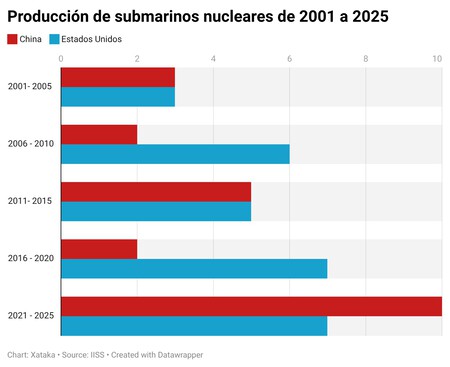
Recent satellite analysis reveals that between 2021 and 2025, China launched 10 nuclear-powered submarines compared to the U.S.’s seven. China’s Bohai shipyard has emerged as the focal point of this industrial revolution. This rapid advancement has allowed China to transform its navy from being significantly behind to leading in submarine production.
Importance of This Shift
The implications of China’s increased submarine production are noteworthy:
- Nuclear Deterrence: New submarines like the Type 094 and planned Type 096 enhance China’s nuclear response capabilities, making preemptive strikes strategically unviable for adversaries.
- Control of Maritime Routes: China’s SSGNs, equipped with advanced missile technology, complicate access for U.S. and allied forces in critical zones like the South China Sea and near Taiwan.
- U.S. Challenges: U.S. Navy Secretary John Phelan has openly critiqued the state of American shipbuilding, citing delays and budget overruns. This makes it difficult for the U.S. to keep pace with China’s rapidly growing submarine fleet.
Comparative Statistics: A Closer Look
The IISS Military Balance 2025 presents enlightening statistics:
- Between 2021 and 2025: China launches 10 submarines, while the U.S. manages only 7.
- Tonnage comparison reveals Chinese submarines weighing 79,000 tons versus the U.S.’s 55,500 tons.
- In terms of active fleets, the U.S. outnumbers China—65 nuclear submarines compared to China’s 12 (plus an additional 46 conventional submarines).
Quality vs. Quantity
While the U.S. still holds a numerical advantage in active submarines, concerns about the quality of Chinese designs persist. According to CNN, Chinese submarines are likely to be noisier and thus more vulnerable to detection. Nevertheless, as noted by a retired U.S. Navy officer, “Biggest Fleets Win,” suggesting that quantity may start to outweigh qualitative factors in strategic military deployments.