
China’s Dominance in Rare Earth Production
There are few strategic natural resources as important as gas, gold, or oil, but one often overlooked yet vital resource is rare earths. These materials are essential across various industries, impacting everything from technology to global geopolitics. Rare earths, comprising a list of 17 metals, play a crucial role in manufacturing and innovation, making a country with significant reserves and production capabilities a potential global power. Currently, that power resides firmly with China, the absolute leader in rare earths, both in terms of reserves and production capacity.
Visualizing China’s Hegemony
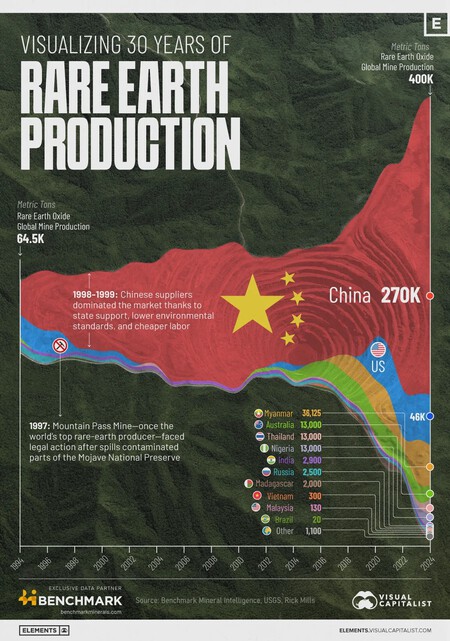
A picture is worth a thousand words. While discussions about China’s power abound, the reality is stark—it began dominating the rare earth market long before many realized. The U.S. Geological Survey provides a complete database to visualize production trends by country from 1994 onward. However, a graphical representation, such as the chart from Visual Capitalist, vividly illustrates China’s impressive hegemony over the years.
30 years of rare earth production. Visual Capitalist
The Meteoric Rise of Production
In just three decades, China’s production share has skyrocketed from 47% to nearly 70% of the 400,000 metric tons expected by the end of 2024. This dramatic increase reflects a rise from manufacturing 31,000 metric tons to an astonishing 270,000 metric tons. For a more illustrative portrayal, this animation by Global Times and Valiant Panda showcases the meteoric rise of China’s dominance.
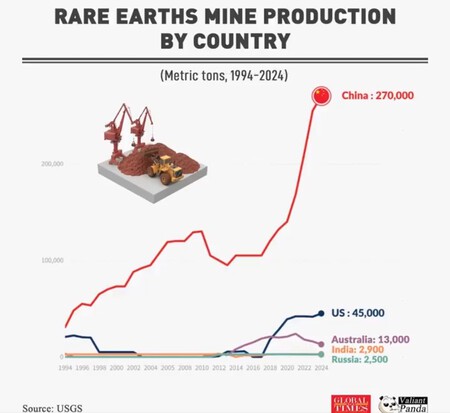
Tap to see the animation. Production by country of rare earths from 1994 to 2024, Global Times
How America Lost Control
In the 1990s, the United States was the world’s largest producer of rare earths, with Mountain Pass being its flagship facility. However, the Mountain Pass environmental disaster in 1997 severely impacted production, causing it to plummet to 5,000 tons and effectively zero in the 2000s. Although the U.S. has begun to recover production in the 2010s, now sitting around 46,000 metric tons, it is evident that China’s ramp-up during the same period established its unassailable position.
The Unstoppable Rise of China
China’s dominance is not solely due to its available resources; it strategically built a complete industry while other nations stood by. With state aid, lower environmental standards, and cheaper labor, Chinese suppliers can offer competitive prices that outmatch Western costs. Achieving high purity in the processing of rare earths requires complex and costly hydrometallurgical processes, a challenge for countries lacking an integrated approach.
Dominance in Refining
While China commands nearly 70% of global production, its position is even more formidable in the refining sector, accounting for approximately 90%. Nations like Australia and the U.S. rely on China for refining their extracted minerals, emphasizing the need for a robust domestic refining capability to achieve true resource sovereignty.
Emerging Players and Future Trends
As geopolitical tensions shape the rare earth landscape, initiatives like Trump’s push for national mining and the EU’s Critical Raw Materials Act signal a shift towards seeking independence from China. Nevertheless, newer players in the industry, such as Myanmar, Thailand, and Nigeria, are emerging, focusing on more scarce elements. However, their stability is compromised by regulatory and geopolitical risks, reminiscent of the challenges many countries face in diversifying their rare earth supply chains.