
Can You Run Windows 98 in a Toaster? The Amazing Journey of a Tech Experiment
When someone claims to have run Windows 98 inside a toaster, skepticism is a reasonable reaction. However, in this case, it involves a modern, smart toaster equipped with a touchscreen, setting the stage for a fascinating technological experiment. This journey not only challenges our perceptions of kitchen appliances but also showcases the ingenuity behind integrating retro technology into contemporary devices.
A Toaster with Windows: The Concept
The project originates from the “Throaty Mumbo” channel, where the creator has taken the R180 Connect Smart Toaster—a device hailed as the world’s first connected toaster—and transformed it into a curiosity from the 90s. Instead of forcing Windows 98 onto the original hardware, the designer opted for a clever two-tier architecture. This structure allows the physical controls and the operating system to function in distinct yet cooperative environments.
Understanding the Hardware Components
The next step involved a deep dive into the internal communications of the toaster. Using a logic analyzer—an electronics tool—the creator connected to the wiring between the touchscreen and the control board. This brought to light the internal command flow, revealing that the toaster exchanges packets every 30 milliseconds, coordinating its temperature, tray movement, and operational states.
Implementing the Raspberry Pi Pico
Deciphering the command flow enabled the next stage of the project: gaining control of the internal communications. Enter the Raspberry Pi Pico. This tiny device intercepts the original signals and generates new ones, thus governing how the toaster operates. This approach does not require a complete redesign; instead, it strategically positions itself to decide the device’s operational aspects, such as heat levels and tray movements.
Installing Windows 98: The Dual System Approach
To run Windows 98, a second piece of hardware was necessary: a Raspberry Pi 5, functioning as a small computer coexisting with the toaster. By utilizing this setup, compatibility and power were ensured to load the vintage operating system. To maintain the retro feel, the project deployed a 3D-printed casing styled after 1990s technology, complete with a 7-inch screen that enhances the nostalgic experience.
Creating the Toast.exe Experience
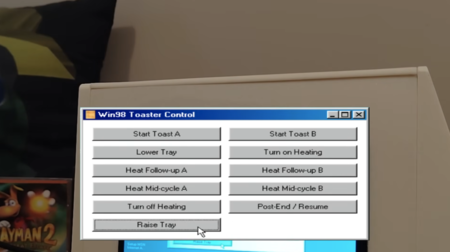
The journey does not end with simply booting up Windows 98. A custom program named “toast.exe” acts as the interface, guiding users through the process using the familiar Windows 98 desktop. Users must manually locate the executable and activate commands to control aspects like heating cycles and tray movements.
In conclusion, Windows 98 doesn’t merely exist within the confines of the original toaster—it represents a unique fusion of modern technology and nostalgic computing. This ingenious project demonstrates how everyday objects can be reimagined, turning an ordinary toaster into a hybrid marvel that continues to perform its traditional function while resurrecting the computing experience of a bygone era.
Images | Throaty Mumbo (YouTube)