
Understanding Personal Income Tax in Different Countries
Discussing taxes can often lead to misunderstandings and conflict due to misconceptions surrounding economic principles. One of the most debated types of taxation globally is the Personal Income Tax (IRPF). A common question arises: How much IRPF do we actually pay? The answer, as it turns out, is not simple.
The Reality of Taxation
In many countries, particularly in Spain, people often express discontent about the amount of money they perceive as “taken” from them in taxes. It’s essential to note that most countries have tax systems similar to personal income tax, with exceptions like Monaco and Kuwait. This raises two vital questions: what portion of income is allocated to personal income tax, and how would my tax burden change if I lived elsewhere?
A Closer Look at Personal Income Tax
To clarify, personal income tax is a progressive tax, meaning that the percentage paid increases with the amount earned. A common error occurs when discussing high incomes—many believe that a person earning a high salary pays nearly 47%, but this is deceptive. For instance, under the current system, the first €12,450 is taxed at 19%, while income from €12,450 to €20,199 is taxed at 24%, and so on.
The tax structure is also dependent on regional laws, as personal income tax can differ across autonomous communities within countries. Importantly, a personal and family minimum is established, ensuring basic needs are met before taxation applies; in Spain, this minimum is currently set at €5,550 for a single individual.
Exploring Income Tax Calculators
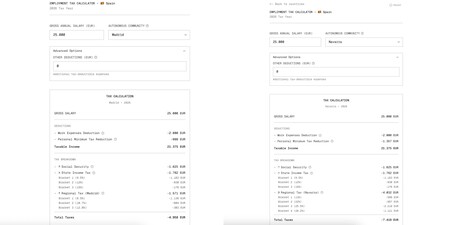
To ease the complexity of tax calculations, several online tools are available. For instance, Spain’s Treasury Department even offers its own calculator for taxpayers. Yet, if you seek a more intuitive and comparative approach, consider visiting this website by Benjamin Akar. Despite being in English, it efficiently allows users to estimate and compare their tax obligations.
Comparing Taxation in Different Regions
To illustrate the differences, let’s take a look at two autonomous communities: Madrid and Navarra. Suppose an individual earns €25,000 annually in both regions. Madrid boasts lower minimums and tax brackets, offering better opportunities for maximizing take-home pay. On the other hand, Navarra, with its distinct tax laws and regional Treasury, provides different deductions and benefits that can influence a taxpayer’s overall experience.
Now, shifting the discussion to Germany, particularly its capital, Berlin, we observe a different landscape. While Germany maintains a high exempt minimum where initial earnings are untaxed, various social security contributions and pension taxes come into play, complicating the total tax burden.
The European Tax Mosaic
The European Union features a diverse array of tax models, all aimed at funding welfare systems. Countries employ different systems: progressive models in Spain, France, and Germany; flat systems in Bulgaria or Romania; and the Nordic model in Denmark or Sweden with high tax rates funding extensive public services.
In this context, Spain occupies a medium-high position within the EU concerning tax rates, averaging around 45%. Some regions, like Valencia or Catalonia, can witness rates exceeding 50%, but only for substantial incomes.
Concluding Thoughts
Taxation remains a contentious issue throughout Europe, leading to numerous misconceptions and debates. It’s crucial to utilize resources and calculators to gain a clearer understanding of one’s obligations, as well as to consider relocation to optimize tax benefits.