
The Mystery of Water on Mars
The enigma surrounding water on Mars continues to unfold. Recent missions, such as Curiosity exploring Gale Crater, provide compelling evidence for the presence of liquid water lakes that may have existed for thousands, if not millions, of years. Climate models depict early Mars as a frigid environment, while seasonal ice shields further illustrate its inhospitable conditions. Yet, one of the pressing questions remains: How much water was there on Mars and when did it exist?
Mars Was (Half) Blue
A groundbreaking study published in the npj Space Exploration journal supports the concept of a once interconnected water system on Mars. Lead author Ignatius Argadestya emphasizes this by stating that “our results show that in the past, it was a blue planet, similar to Earth.” Evidence from the research suggests that Mars was once home to a vast ocean stretching across its northern hemisphere, dominating half of the red planet.
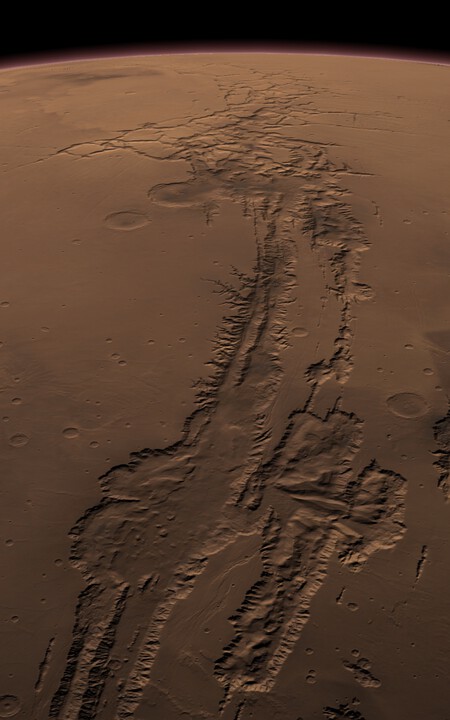
Image Credit: Celestia Valles Marineris
The “Deltas” of Mars
Further investigation has focused on geological formations known as deposits with steep fronts, located in the Valles Marineris, the largest canyon system in the solar system. Utilizing high-resolution images from Cassis of the European Space Agency and NASA’s CTX and HiRISE, researchers have identified deposits that resemble Earth’s river deltas. These formations suggest that water once flowed from Martian mountains, creating branching channels that led to lakes or seas, where sediments settled.
The deltas discovered on Mars end at an abrupt step, consistently observed between -3750 and -3650 meters relative to the planet’s reference level, indicating a stable water body in its prime.
About 3.37 Billion Years Ago
This fascinating evidence points to a significant period in Martian history, approximately 3.37 billion years ago, when the planet harbored a sea-like body of water. These deposits were formed during the Late Hesperian and Early Amazonian periods, marking a time of maximum liquid water presence on the Martian surface.
Why Is This Important?
The conclusions drawn from this research offer more than just insights into Martian history. The identified deltas provide a valuable base for studying sediments in search of potential traces of life. After all, where there is water, the possibility of life may also exist.
Moreover, understanding how Mars transitioned from a water-rich world to the frozen desert we see today poses another intriguing question. Initial findings suggest that the progressive drying of the planet is evidenced by detecting desiccation cracks and dunes, indicating a gradual arid environment replacing the once-aquatic landscape.
Concluding Thoughts
As our understanding of Mars evolves, these discoveries highlight the planet’s potential for once hosting a rich environment similar to Earth. Future research will not only focus on the history of water but also aim to uncover how this incredible transformation occurred, enriching our knowledge of planetary evolution and the conditions necessary for life.