
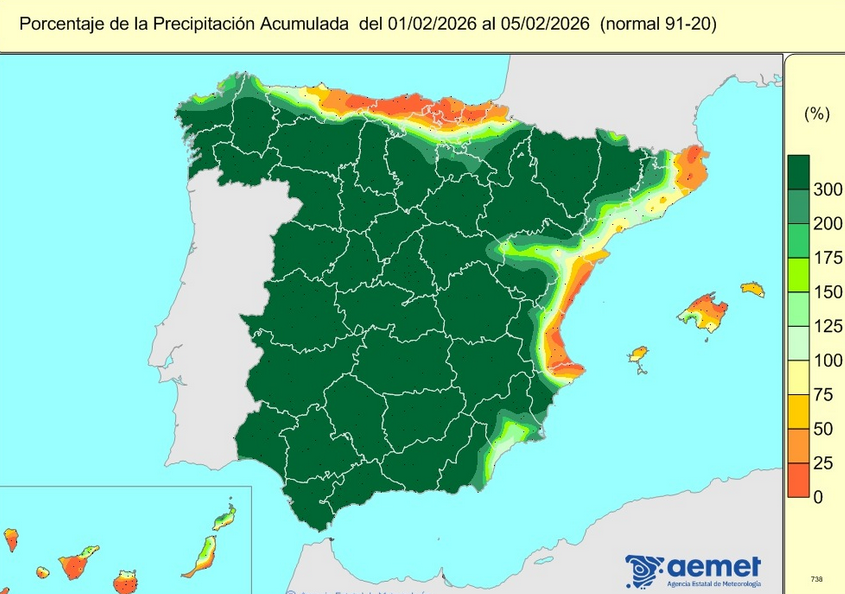
Rainfall has been relentless since the start of 2026, affecting almost all of Spain. Intense and persistent showers have been observed in many areas, particularly in the town of Grazalema, which was evacuated as it experiences unprecedented levels of precipitation, pushing the limits of soil and reservoir absorption.
Why Is It Raining So Much?
According to Aemet (the Spanish Meteorological Agency), the recent weather conditions have been influenced by a strong polar circulation that has moved through mid-latitudes, facilitating the passage of successive storms towards the Iberian Peninsula. This has resulted in abundant rainfall accompanied by intense westerly winds and maritime conditions.
In recent weeks, a highly wavy jet stream has allowed cold air intrusions and storm systems to move southward. It’s notable that the Azores High has remained at a comparatively low latitude for six weeks, enabling these storms to enter from the Atlantic. “This is not common. In previous years, we had anticylonic conditions in January and February, even mentioning a second winter tourist season. This year has been the opposite,” explained Jorge Olcina, an expert in water and land management from the University of Alicante.
Have We Experienced the Wettest January in Spain?
No, but it was among the wettest. Aemet reports that January was the second wettest in the 21st century, with 119.3 mm of precipitation across Spain. Only 2001 exceeded this, which saw 131.5 mm, making it the seventh wettest January since 1961, when systematic records began.
Precipitation was 85% higher than the average for January during the 1991-2020 period, classifying it as a “very wet month.” For example, in the Community of Madrid, rainfall was 52.4% above historical averages (89.7 l/m² compared to 58.9 l/m²).
How Much Rain Fell in February?
As Rubén del Campo, Aemet spokesperson explains, “in almost all of Spain, rainfall during the first five days of February has been over three times the normal amount for this period, except in the Cantabrian region, Mediterranean areas, and both archipelagos, where precipitation was minimal.”
Notably, over 900 mm was recorded in Grazalema, a figure comparable to the annual average for Oviedo, within just a few days.
What Was the Rainiest Day of This Episode?
February 3 marked the second rainiest day ever recorded in Spain, with Grazalema receiving 577 liters per square meter, only surpassed by the rainfall during the severe weather event in Valencia on October 29, 2024.
How Much Has It Rained in Grazalema Since the Year Began?
Grazalema had record rainfall in January, accumulating 1,295.5 mm, and saw one day with 236 liters of rain on January 26. Notably, in just ten days, Grazalema received over 1,300 liters, more than the annual rainfall for A Coruña. Since the start of 2026, total rainfall in the area has surpassed 2,000 liters.
Have There Been Other Periods of Similar Rainfall in Grazalema?
Yes, although the initial five days of February 2026 exceeded all previous records for Grazalema, previously set in December 2009.
Why Does It Rain So Much in Grazalema?
Grazalema is considered one of Spain’s rainfall hotspots due to its geographical characteristics. Situated near the Strait of Gibraltar, it acts as a funnel for incoming storms, and its mountainous terrain captures moisture-laden clouds, leading to heavy precipitation.
How Many High-Impact Storms Have We Had in 2026?
The current episode of heavy rainfall has already seen seven high-impact storms: Goretti, Harry, Ingrid, Joseph, Kristin, and Leonardo, with Marta incoming this weekend. Last December also witnessed three impactful storms: Davide, Emilia, and Francis.
How Exceptional Is This Weather Episode?
Current weather conditions are considered exceptional, with a marked and persistent Atlantic circulation leading to an unusually extended humid streak, without precedents in climatological records. According to José Miguel Viñas, meteorologist with Meteored, such a scenario occurs roughly once every 20 years, and this year has seen it unfold.
What Is the Current Water Level in Reservoirs?
As of February 3, official data indicates that Spain’s water reserves are at 67.3% of total capacity, a notable increase from 57.2% the previous week. Reservoirs currently hold 37,706 cubic hectometers of water, gaining over 4,500 cubic hectometers in just a week.
When Will It Stop Raining?
Although storm Leonardo is weakening, it does not indicate an end to the rainfall. Meteorologist Mar Gómez notes that storm Marta will influence the region this weekend, leading to further precipitation—especially in already overwhelmed areas. According to forecasts, by mid-February, an anticyclone may settle, potentially bringing respite and normal weather patterns.