
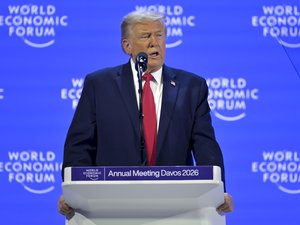
In a recent speech at the Davos forum in Switzerland on January 21, American President Donald Trump launched a sharp critique of Europe, with particular emphasis on France. The focus of Trump’s remarks was immigration, a recurrent theme in his agenda.
### Trump’s Opening Remarks
Trump began his address with a confident declaration: “I am happy to be here to speak in front of many friends, and a few enemies too…I came here with good news from America.” He emphasized the role of the United States as “the engine” of the world economy, stating, “When America prospers, the world prospers. When America is bad, it’s bad for everyone.” This assertion not only reflects his America-first mentality but also sets the stage for his sharp critique of European policies.
### Critique of European Policies
Following his initial remarks, Trump shifted his focus to Europe, declaring, “Europe is not going in the right direction.” This broad statement was accompanied by specific references to France, where he contended that parts of the continent had become “unrecognizable.” Trump has long criticized what he perceives as lax immigration policies in Europe and pointed out that “massive illegal immigration” is a wasted potential for European capitals. While Trump maintained that the United States retains friendships within the European Union, the tone of his words suggested a stark warning regarding the implications of ongoing immigration challenges.
### Macron “Tried to Act Tough”
In a noteworthy interjection, Trump claimed that he had previously told French President Emmanuel Macron, who he said “tried to act tough,” that France had been exploiting the United States for over 30 years regarding drug policies. This comment signifies a deeper frustration with what Trump views as unfair trade practices. The dialogue continued as Trump transitioned to a discussion on customs duties, reinforcing his hardline stance on trade relations.
### The Implications of Trump’s Remarks
Trump’s comments at Davos are not merely political rhetoric; they carry significant implications for Franco-American relations moving forward. His characterization of Macron’s leadership as tough-guy posturing could strain diplomatic ties, especially given the historical alliance between the two nations. Moreover, Trump’s framing of immigration and trade issues reflects a broader view that challenges traditional collaborative approaches to global policy-making.
### Conclusion
As Trump paints a grim picture of Europe, particularly France, the fallout from his remarks may resonate deeply within the French political landscape and beyond. Macron, already facing internal challenges, must navigate these external pressures with a strategic approach to maintain France’s standing in international affairs. The discourse at forums like Davos not only shapes public perception but also sets the tone for the forthcoming dialogues on crucial issues such as immigration, trade, and national sovereignty. As both leaders continue to assert their positions, the international community will be watching closely.