
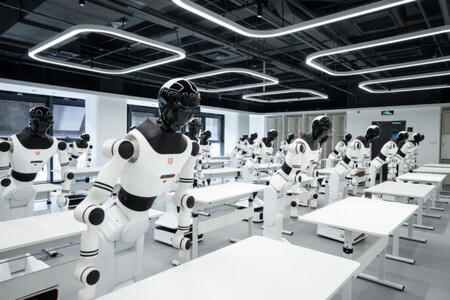
Despite the significant advancements in humanoid robotics over recent years, these technologies are still not ready for mass consumer markets. High costs and limited effectiveness impede their widespread adoption.
Training Robots: A Pioneering Approach
In China, a groundbreaking approach has been initiated to enhance the capabilities of humanoid robots. The country has established over 40 public training centers where human workers don virtual reality headsets and motion sensors to repetitively perform tasks like opening microwaves, folding clothes, and tightening screws. This extensive practice is essential to generate the rich movement data that robots require to learn how to execute these actions autonomously.
Investment Surge in Robotics
The Chinese government has recognized embodied artificial intelligence (AI) as a national priority, leading to significant investments in the robotics industry. With over 150 companies dedicated to developing humanoid robots, China aims to establish itself as a leader in this field. Goldman Sachs predicts that the robotics market could reach $38 billion by 2035.
The Need for Human Data
Unlike large language models that learn from online texts, robots require complex datasets, including visual information and motion data. Gathering this data is not feasible from the internet, thus prompting local governments to invest in state-funded facilities operated by robotics firms.
Understanding the Training Process
An illustrative case involves Kim, a 20-year-old student working at a training center in Shanghai. Each robot is paired with two trainers who use motion capture devices to record hundreds of action sequences daily. For instance, teaching a robot to place a frying pan on a stove might require as many as 1,250 repetitions.
Realistic Training Environments
These training facilities are designed to simulate real-world scenarios, including automobile assembly lines, logistics warehouses, and domestic environments. In Beijing, one center spans 10,000 square meters and features 16 different scenarios, providing a comprehensive training ground for humanoid robots.
The Challenges of the Method
Some robotics researchers question the efficiency of this training approach. According to Ken Goldberg from UC Berkeley, while this data-gathering method is promising, it is labor-intensive and slow, posing challenges to reaching desired learning outcomes quickly.
Potential Risks in the Industry
Amid this growth, the National Development and Reform Commission of China has issued warnings about potential bubbles in the humanoid robotics market. Experts suggest that overcapacity may arise, making it crucial for the industry to navigate growth wisely.
Initial Successes
Despite these challenges, the first “graduated” robots from these centers are starting to demonstrate operational skills, with over 20 tasks learned and success rates exceeding 95%. These robots have begun to assist in various sectors, working in factories, as couriers, and conducting inspections in electrical facilities.