
Argentina as a Plurilateralist Nation
Free Trade Agreements and Economic Openness
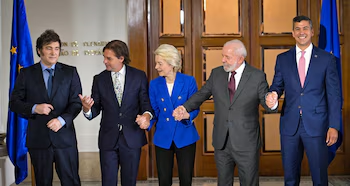
Argentina has recently taken significant steps toward economic openness and integration into the global market. The signing of the Free Trade Agreement between Mercosur and the European Union marks a pivotal moment, establishing one of the largest trade zones in the world. This initiative aligns with the administration of Javier Milei, whose economic policies favor free trade and market liberalization. Economy Minister Luis Caputo has noted the positive implications of increased imports, such as Chinese cars, for bringing down consumer prices and enhancing competitiveness.
The Global Trade Mosaic
A study by the Boston Consulting Group (BCG) sheds light on the future of global trade amidst rising geopolitical tensions and protectionist policies. According to BCG, resilient global trade is projected to grow by 2.5% annually through 2034, even as fragmentation increases in the international trade landscape. The study identifies four potential scenarios for the coming decade, including self-sufficiency, regional strengths, multilateral trade based on rules, and a “multimodal mosaic”—the latter being the most likely scenario.
Argentina’s Unique Position
In this context, Argentina embodies the characteristics of a “plurilateralist” country. This category prioritizes multilateral trade rules and agreements while also maintaining significant trade relationships with countries within the BRICS bloc, notably Brazil and China. Notably, Argentina’s geopolitical orientation aligns with the United States, despite its strong trading ties with these emerging economies.
Impacts of Geopolitical Fragmentation
The BCG study emphasizes that while global trade may be more resilient than anticipated, the trade routes and partnerships through which goods circulate will inevitably change. There won’t be a single set of rules governing international trade anymore; instead, the future will consist of a complex mosaic of relationships and priorities among countries. As noted by BCG Managing Director Alfonso Astudillo, the companies that adapt to this evolving landscape will strategically position themselves for future growth.
Trade Trends and Economic Forecast
As trade dynamics shift, specific consequences are anticipated. The U.S. is projected to experience a decline in its share of global goods trade due to its “America First” policies, which prioritize domestic production over international imports. This shift is exemplified by the significant increase in tariffs, from covering 13% to 61% of U.S. imports since 2025. Meanwhile, countries categorized as “plurilateralists,” including Argentina, are expected to experience above-average trade growth among themselves, aided by their commitment to multilateral agreements.
Challenges Ahead
Despite the optimistic forecasts, Argentina faces challenges, most notably its ongoing trade deficit with China, which has reached USD 100 billion since 2008. While Argentine officials celebrate initiatives like the reform of trade agreements, difficulties persist in navigating complex imports—such as potential anti-dumping investigations against Chinese washing machines, which now dominate the local market.
Conclusion
As global trade systems reorganize, Argentina stands at a crossroads, characterized by its unique amalgamation of plurilateral tendencies and strong regional ties. The challenges and opportunities that lie ahead will shape not only Argentina’s economic landscape but also its strategic positioning in the evolving global trade mosaic. As Astudillo aptly suggested, leaders who incorporate geopolitical considerations into their strategic planning will likely thrive in this era of uncertainty.