
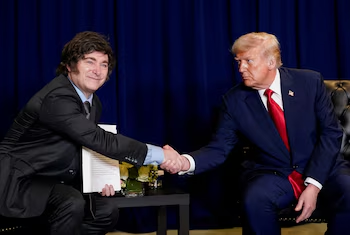
Trump’s Strategic Pivot to Argentina
The recent financial backing for Argentina by the U.S. government, under President Donald Trump, represents a significant strategic shift aimed at curbing China’s increasing influence in Latin America. This move, as reported by Bloomberg, coincides with a challenging period for Argentina’s Libertarian government under President Javier Milei.
In September, the U.S. Treasury disbursed USD 20 billion to stabilize the Argentine peso, ensuring some degree of economic stability ahead of legislative elections. This decision not only demonstrates a commitment to Argentina but also strengthens the ties between Washington and Milei’s administration.
The Donroe Doctrine and Its Challenges
While Trump’s foreign policy has often been exemplified by the situation in Venezuela, the Bloomberg article highlights Argentina as a more telling case of the “Donroe Doctrine.” This newly coined term seeks to reestablish U.S. dominance in the region, presenting significant obstacles against two decades of Chinese economic advances.
Issues surrounding China’s foreign direct investment, which totaled over USD 180 billion as of late last year, underscore the complexity of the U.S. strategy. Remarkably, this investment has surpassed U.S. influence in 14 of the continent’s 33 countries since the early 2000s.
Journalist Manuela Tobias notes that the recent U.S. intervention in Argentina is unprecedented since the 1995 Mexican exchange crisis, signifying the importance of Argentina in U.S. foreign policy considerations.
Javier Milei’s Geopolitical Positioning
In response to U.S. support, Milei has enacted policies that obstruct Chinese projects. Following the aid, he imposed restrictions on the construction of a Chinese telescope in the Andes and halted an USD 8 billion facility backed by Beijing. Furthermore, he blocked a Chinese company’s bid to dredge the Paraná River—a vital Export route for Argentina.
Milei’s close relationship with Trump is further evidenced by numerous visits to Mar-a-Lago and other conservative venues in the U.S. His political maneuvering culminated in an impressive legislative victory in October, enabling him to advance his economic transformation agenda.
Balancing Relations with China
Despite U.S. support, Argentina’s trade with China is notable. Exports to China surged by 57% in 2025, in stark contrast to a 26% increase in shipments to the U.S. This highlights Milei’s delicate balancing act, as he recently renewed a currency swap line with the People’s Bank of China worth USD 18 billion.
Notably, the Chinese space facility within Argentina, which has raised military concerns from Washington, continues to operate, reflecting Milei’s intent to maintain ties with Beijing.
The Broader Implications for U.S. Foreign Policy
Bloomberg’s analysis underscores a difficult reality for Trump: despite his aspirations to curtail China’s influence in Latin America, the region remains a complex landscape. The piece argues that for the Monroe Doctrine to regain its political effectiveness, the U.S. must profoundly rethink its economic and diplomatic engagements in the area.
Milei’s upcoming visit to China, as mentioned in a recent interview, indicates that the South American nation seeks to navigate these geopolitical waters with caution. The balance of power in Latin America is shifting, and how effectively the U.S. adapts to these changes will define its role in the region moving forward.