
The crisis with RAM prices is prompting tech enthusiasts to take matters into their own hands. With memory components found in nearly every device we use daily, the dramatic hikes in RAM prices are creating ripples throughout the tech industry. In response to these soaring costs, some users have begun building their own RAM.
The Price Crisis: An Overview
Untenable. Over recent months, RAM prices, especially DDR5 modules, have surged uncontrollably. What once sold for between 100 and 150 euros now frequently exceeds 350 euros. Much of this inflation can be attributed to the booming demand for DRAM in artificial intelligence applications. Notably, companies like OpenAI have monopolized a staggering 40% of the global DRAM production, leaving average consumers facing the brunt of this supply crunch.
The Long-Term Forecast
Unfortunately, there are no quick fixes in sight. The analysis firm IDC predicts that the RAM shortage may persist until 2027, suggesting that consumers must brace themselves for a continued struggle with high prices.
Building Your Own RAM: A DIY Approach
Cheap Adapters. In light of the price crisis, some innovative users have started constructing their own RAM solutions. One popular method involves utilizing SODIMM to UDIMM adapters. A recent video by The Hardware Canucks showcased how this setup performed well across various systems, including Ryzen 7000 and Intel LGA 1700.
These adapters typically cost between 10 and 15 euros, allowing users to purchase relatively inexpensive DDR5 SODIMM modules—used in laptops—and connect them to their desktop systems. While this method is more budget-friendly, it’s worth noting that the data transfer speeds achieved can vary widely, ranging from 4,800 MT/s to as high as 5,800 MT/s, depending on the specific setup.
Performance Metrics
Despite potential speed variations, tests show that the performance difference is largely negligible for most users. Comparisons using an RTX 5090 and a Ryzen 9800X3D revealed only a 5%-7% difference at worst when compared to standard DDR5-6000 memory.
A More Radical DIY Solution
Another approach emerged from Russian modder VIK-on, who crafted a 32GB RAM stick from two 16GB SODIMM chips, a Chinese PCB, and a heatsink sourced from AliExpress. This total cost of 17,015 rubles (approximately $218) underscores the extreme price disparities; in Russia, an equivalent module would typically cost three times as much.
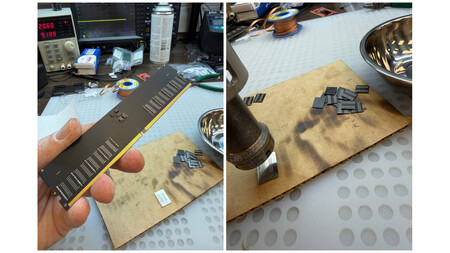
Images: VIK-on
After physically assembling the components—an operation requiring specialized equipment and soldering skills—VIK-on successfully integrated ADATA firmware to create an XMP profile that enabled the memory to run at 6,400 MT/s. This achievement demonstrated that homemade RAM could indeed function quietly in gaming environments.
The Growing DIY Culture
Between the Lines. The fact that building RAM at home can be economically feasible indicates just how strained the current market is. Moreover, the challenges of soldering memory chips mean this option is not for everyone; it requires a certain level of expertise and comes with risks.
While the adapter method shows promise, it’s likely that these DIY solutions will remain niche. Many will prefer the convenience—even at a premium—over the potential pitfalls of tackling soldering projects or using third-party adapters. If the RAM crisis continues for several more years, a secondary market for refurbished modules could emerge, possibly offering one last option for cost-conscious consumers.
Cover image | Andrey Matveev