
The president of the United States highlighted the positive tone of the exchange and assured that the dialogue is moving into a new stage
The transition in Venezuela, led by the United States following the arrest of Nicolás Maduro, is gaining momentum. President Donald Trump emphasized on Tuesday the commitment of his administration to restore Venezuela’s strength on the international front.
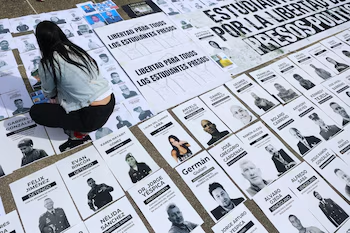
Simultaneously, the release of political prisoners, framed by the regime as a reconciliation effort, is unfolding at a rate deemed inadequate by families and advocacy groups, who are calling for more releases of those unjustly detained.
Jorge Rodríguez, the president of the National Assembly and chief negotiator for the Chavista regime, has publicly stated that over 400 individuals have been released since December. However, the legal defense organization Criminal Forum disputes this figure, alleging that the true number is significantly lower and accusing the transitional government of opacity and manipulation regarding these figures.
The following updates cover important developments in this situation:
Human Rights Groups Respond
The Committee for the Freedom of Political Prisoners (CLIPP) criticized the Chavista regime for using the release of prisoners as a “propaganda tool” in Venezuela and highlighted the need to acknowledge the suffering of families affected by political imprisonment.
“Political prisoners are not tools of propaganda. They are human beings with stories and families who suffer daily. We demand respect for their pain,” stated the NGO.
The organization questions the regime’s claimed figures, stating these do not correlate with official data published since December 25, 2025.
CLIPP insists on maintaining transparency, calling for a detailed release list outlining each individual’s identity, release date, detention center, and conditions.
Moreover, they assert that more than a thousand individuals remain arbitrarily detained, demanding their immediate release and the annulment of unjust legal cases.
The US Senate Blocks Military Action Resolution
In another significant development, the US Senate blocked a resolution that sought to require congressional authorization for any future military actions in Venezuela. The vote concluded with a tight 51-50 margin, allowing President Trump the flexibility to act without congressional barriers.
Trump had strongly influenced Republican senators to vote against the resolution. Only three party members sided with the Democrats, insufficient to alter the outcome.
Trump emphasized, “We will not allow impediments when it comes to protecting freedom in Venezuela.” This decision ensures quick governmental action in response to the ongoing crisis in the country.
A Notable Recent Conversation
President Trump confirmed on Wednesday that he had a “long conversation” with Delcy Rodríguez, the newly appointed leader of the Chavista regime. He expressed optimism about the future of US-Venezuela relations, remarking that both countries are seeing “extraordinary” progress.
Trump detailed that the conversation involved key topics such as oil, minerals, trade, and national security.
“We just had a great conversation today; she is a fantastic person. I mean, she’s someone with whom we’ve worked very well,” Trump stated, noting the support of Secretary of State Marco Rubio in these discussions.
He further affirmed, “I think we are getting along very well with Venezuela,” indicating the possibility of a new chapter in diplomatic relations.
The Release of Political Prisoners
Following the ongoing dialogue, calls have intensified for the complete release of political prisoners in Venezuela. Activists maintain that arbitrary detentions have persisted, causing lingering concerns about justice and transparency in the Venezuelan judicial system.
The situation exemplifies a delicate balance between the political machinations of the current regime and the pressing demands for human rights reform from both citizens and international observers alike.
As the landscape continues to evolve, the world watches closely, anticipating actionable changes that prioritize human rights and democratic principles in Venezuela.