
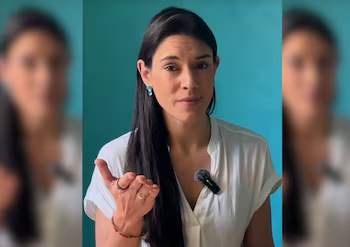
The Emotional Thermostat: Insights from Marta Jiménez
The interpretation of our emotions and thoughts profoundly influences the balance and quality of our lives, according to neuropsychologist Marta Jiménez. By questioning the roots of our emotions and sensitivity, we can mitigate emotional responses that lead to frustration, anxiety, and mental fatigue.
Understanding Sensitivity and Emotional Calibration
“You don’t explode at everything because you are ‘too sensitive,'” Jiménez explains. “You explode because your emotional thermostat is poorly calibrated.” This statement emphasizes that our emotional reactions are based on the mental instructions we provide ourselves. Rather than viewing emotional ups and downs as excessive sensitivity, Jiménez suggests they stem from a maladjustment between our internal demands and reality.
The Role of Perfectionism
Jiménez identifies perfectionism as a significant trigger for emotional instability. When we adopt an internal dialogue focused on perfection, even minimal failures can lead to feelings of frustration or anxiety. However, she reassures us that change is possible: “When you change those instructions to ‘I’m learning’ or ‘making mistakes is normal,’ your system stops jumping at the slightest provocation.” This shift in mindset can lead to a more balanced emotional response.
Recalibrating Your Emotional Thermostat
Like a thermostat, our emotions continuously monitor our environment and mental state. They activate in response to changes, but the critical question is: who controls the activation threshold? According to Jiménez, it’s the mental instructions we program ourselves with. Perfectionism can set off alarm bells at the slightest divergence from expected outcomes. Embracing the idea of learning and normalizing mistakes can lower our emotional alertness.
The Importance of Coherence Between Thought and Reality
Jiménez posits that the gap between our thoughts and lived experiences intensifies internal alerts. “The more coherence there is between what you think and reality, fewer internal alarms will be activated,” she states. This insight highlights the importance of avoiding self-deception and shifting our internal dialogue.
Living with Intent
In her videos, Jiménez encourages viewers to remember that life’s challenges are transient. “You are just passing through,” she asserts, and we should focus on experiencing life rather than trying to control everything. By taking life less seriously, we can foster richer, more realistic experiences.
Jiménez challenges us to reconsider how often we treat our thoughts as absolute truths. Questions like, “What if I lose control?” or “What if I’m wrong?” often lead to unnecessary anxiety. Acknowledging the impermanence of life can shift our perspective: “The only thing that matters is living with intention,” she emphasizes.
Conclusion
By recalibrating our emotional thermostats and embracing a more realistic and compassionate internal dialogue, we can navigate life’s complexities with greater ease. Marta Jiménez’s insights offer valuable guidance in transforming our emotional landscape for a more fulfilling existence.