
The End of Impunity: The Fall of the Venezuelan Dictatorship
A Historic Shift in the Hemisphere
Today, our hemisphere is witnessing a momentous change. For months, the United States has executed an unprecedented naval deployment in the Caribbean, amounting to hundreds of millions of dollars. President Donald J. Trump made it clear that this was not mere theatrics; he repeatedly stated that action was imperative as the Venezuelan situation became untenable.
Operation Absolute Resolve
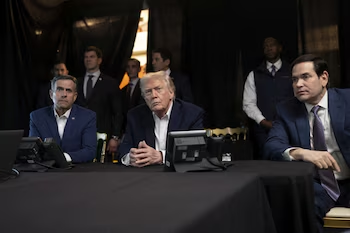
Recently, the U.S. undertook Operation Absolute Resolve, executed under Trump’s direct supervision with substantial input from Secretary of State Marco Rubio. In less than three hours, dictator Nicolás Maduro and his wife were apprehended. This operation is not merely a tactical victory; it marks a significant political determination. The United States opted for decisive action instead of remaining inactive amid years of complicity regarding Maduro’s regime.
A Unique Context for Intervention
Recognizing that military intervention is typically not ideal for resolving political conflicts, the U.S. justified its actions in Venezuela as a necessary defense against a hybrid threat that jeopardized regional and national security. The fall of Maduro not only serves Venezuelans but also communicates a powerful dissuasive message across the hemisphere—sovereignty cannot shield organized crime or global terrorism.
Implications for Regional Security
The extraction of the Venezuelan dictator alters the regional security framework. Venezuela has long served as a logistical hub for drug trafficking, organized crime, and terrorism, directly impacting the U.S. By dismantling the core of this criminal network, there is a realistic opportunity to counteract the criminal expansion that has marred Latin America over the past decade.
A Constitutional and Democratic Transition
In a recent press briefing, President Trump outlined preliminary steps for ensuring Venezuela’s stability and facilitating a transfer to a legitimate national government. Unlike other authoritarian collapses, Venezuela offers a crucial asset—a recognized, democratically elected government. The transition must occur on political, institutional, and security fronts without disrupting public services.
The Importance of Justice
The military action is seen as an act of self-defense, driven by a moral, legal, and strategic justification. The regime led by Maduro was not merely a government; it was a criminal organization engaged in transnational operations, posing a direct threat to the U.S. The grounding principles of this intervention emphasize accountability and the necessity for justice—a critical factor for lasting peace in Venezuela.
Consequences Beyond Venezuela
Now under custody, Maduro and his regime’s coalition face scrutiny, as many actors will need to answer for their actions. The U.S.’s current knowledge will yield significant ramifications for regional leaders implicated in crime and corruption.
A New Era of Accountability
The ramifications extend to neighboring countries like Cuba and Nicaragua, both reliant on Venezuelan support. Without this backing, these regimes are more vulnerable to sanctions and international isolation.
Conclusion: Dismantling Authoritarianism
This operation signifies a strategic and political victory for President Trump, creating an urgent shift in U.S. foreign policy as outlined in its National Security Strategy. The era of impunity for authoritarian regimes in the hemisphere appears to be coming to an end. With the principles of America First, the U.S. not only showcases its military superiority but reinforces its commitment to establishing a safer and more democratic hemisphere for all.