
The Far-Right’s Academic Ambitions and Historical Erasure
Understanding the Threat in Academia
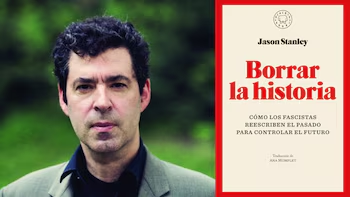
The rise of the far-right in educational spaces is a growing concern, as highlighted by philosopher Jason Stanley in his book Erase History: How Fascists Rewrite the Past to Control the Future. This 228-page work delves into how control over historical narratives serves as a cornerstone for fascist ideologies, arguing that universities become battlegrounds for ideological warfare.
Stanley’s insights are timely, especially in light of events like far-right agitator Vito Quiles’ recent tour across various Spanish universities. His appearances, which were largely uninvited and met with resistance, exemplify an alarming trend of extremism seeking legitimacy in academic environments. Quiles’ tour was portrayed as a mission to promote “truth” in spaces purportedly hostile to conservative views.
The Role of Education in Political Culture
According to Stanley, the educational system is integral to forming a political culture. He argues that fascist movements utilize educational frameworks to eliminate or distort historical narratives that contradict their agendas. This selective storytelling aligns with authoritarian goals, allowing for a simplified and often glorified version of history to take root.
The implications are profound—by controlling educational narratives, authoritarians can restrict critical thinking and foster a monolithic perspective that overlooks the complexities of historical events.
Historical Erasure and Its Consequences
Although Erase History primarily discusses examples from the U.S., Hungary, Russia, and Germany, its lessons resonate deeply in the Spanish context, particularly concerning perceptions of the Franco dictatorship. Alarmingly, surveys reveal that a significant segment of today’s youth—those born after Franco’s death—holds favorable views of his regime. This troubling phenomenon points to a cultural amnesia that erodes democratic values and opens the door for authoritarian ideologies to flourish.
Journalist José Antonio Martínez Soler has also noted the disturbing “pact of oblivion” among Spanish youth, suggesting they have been subject to a sanitized version of history that paints a rosy picture of dictatorship. These sentiments can be seen as a potential recruitment tool for far-right ideologies.
The Concept of Anti-Education
Stanley introduces the term “anti-education” to describe the deliberate efforts to restrict diverse perspectives in educational discourse. By presenting a skewed version of history, far-right movements aim to justify hierarchical social structures and perpetuate systemic inequalities.
This creates a significant challenge for universities, which are traditionally places for free thought and discussion. Stanley argues that higher education institutions are critical frontline defenses against this creeping authoritarianism and must actively counteract these narratives.
Conclusion: A Call to Action
In a world increasingly susceptible to extremist ideologies, Stanley’s Erase History serves as a crucial reminder of the importance of historical accuracy and the dangers of ideological conformity. Educational institutions must remain vigilant and prioritize diverse perspectives in order to foster critical thinking and informed citizenship. The battle for historical narrative in universities is not just about academic content; it’s about preserving democracy and ensuring that authoritarianism does not take root.