
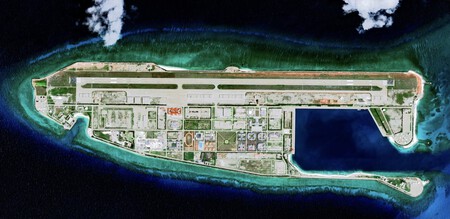
For over a decade, China’s ambitious territorial expansion strategy has captivated global attention as the nation has been dumping vast quantities of sand into the South China Sea. While land reclamation isn’t exclusive to China—Japan has also engaged in similar activities to construct an underwater airport—the scale and intent behind China’s project are particularly astounding, focused primarily on asserting its territorial claims.
Context of the Expansion
The pivotal moment came at the end of 2013 when China dramatically intensified its reclamation efforts, beginning with the massive filling of seven reefs in the Nansha and Xisha archipelagos, also known as the Spratly and Paracel Islands, respectively. By June 2015, the first phase of this operation was effectively complete, completing the initial filling of target areas.
Construction and Infrastructure Development
From 2015 onward, China shifted its focus towards consolidating this new territory. This phase includes the construction of essential infrastructure, such as landing strips, hangars, ports, and radar systems. According to reports from the US-China Economic and Security Review Commission, between December 2015 and October 2017, approximately 12 km² of artificial land was created. While the United States has expressed concern over these developments, Chinese media has taken pride in their accomplishments.
Before and After
The Methodology Behind It
The methods employed for this extensive reclamation are surprisingly straightforward. Chinese engineers cut through coral bottoms and pumped sediments into shallow waters. These materials were then deposited to form dikes or retaining walls, followed by more fill material compacted using heavy machinery. Eventually, this process led to the creation of paved areas, landing strips, and various infrastructures.
The Scale of the Project
The sheer scale of this endeavor is staggering. To put the results in perspective, China’s land reclamation in just 20 months has been reported to be 17 times more than what all other claimants achieved over the previous 40 years combined.
Motivations Behind the Expansion
China’s rationale for this massive investment of resources varies depending on whom you ask. The official narrative suggests that these islands will facilitate rescue missions at sea, enable fishing operations, conduct scientific research, and serve as support points for navigation. There’s also a claim that it bolsters national defense capabilities.
However, neighboring countries express skepticism, viewing these actions as primarily aimed at asserting territorial claims over disputed waters. Japan’s Ministry of Defense has indicated that these structures effectively allow a permanent Chinese military presence in the region.
Military Implications
Recent analyses, such as those from CSIS, emphasize that China’s ongoing activities in the South China Sea are sustained by this extended island construction agenda. There are indications that these emerging islands are equipped with runways suitable for combat aircraft, warship ports, and even potential missile launch platforms.
Rising Tensions
Tensions in the region are palpable as Beijing claims sovereignty over territories disputed by neighboring countries like Vietnam, Taiwan, Japan, and the Philippines. Notably, Vietnam has parallel ambitions and has begun its own land reclamation initiatives.
Ecological Consequences
Despite varying narratives, one undeniable reality is the environmental degradation associated with these artificial islands. Studies indicate that land reclamation has resulted in the significant loss of vital reef systems, estimated between 12 and 18 km². The ecological damage extends beyond local regions, affecting wider systems through sediment dispersal during sand pumping activities.
Moreover, scientific literature highlights that land reclamation leads to devastating ecosystem loss, altering currents and sediment patterns detrimental to neighboring areas. China’s State Oceanic Administration contends that their projects have undergone thorough evaluations and assert they do not harm coral ecosystems, attributing changes instead to global phenomena like climate change.
In summary, while China’s extensive land reclamation efforts serve several strategic objectives, the implications—both geopolitical and ecological—are profound and warrant careful consideration moving forward.
Images courtesy of Ma Wukong.