
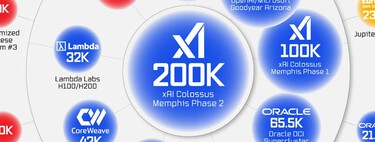
The construction of data centers is proliferating immensely. While the largest facilities can be found in Kolos (Norway), The Citadel (United States), and China, locations such as Botorrita in Zaragoza are following suit. The next frontier for this expansion? Beyond our planet—as tech giants in Silicon Valley aim to set up data centers in space.
Major tech firms are taking significant steps toward this ambitious goal. Former Google CEO Eric Schmidt has invested in Relativity Space, a rocket company focused on this vision. Nvidia recently supported Starcloud’s initiative to send the first NVIDIA H100 GPU into orbit. Elon Musk even outlined a blueprint on Twitter for how it could work: scaling Starlink V3 satellites to utilize high-speed laser links. Jeff Bezos has also predicted that within the next 10 to 20 years, we will witness “giant training clusters” of AI orbiting Earth.
The Moon: A Potential Energy Haven
So why are these tech leaders venturing into space? The answers are multifaceted. AI, notorious for its insatiable appetite for energy, stands to benefit enormously from the unique advantages offered by space. For starters, solar panels in a sun-synchronous orbit can harness energy almost continuously. Additionally, the vast expanses of space allow for large radiators, transforming it into an ‘infinite heat sink’ at -270°C. This means that data centers could function without the immense water resources necessary for cooling on Earth.
While concrete plans for space data centers remain in the early stages, experts like University of Central Florida research professor Phil Metzger suggest that within a decade, achieving financial viability is plausible. Metzger believes that deploying AI servers in space could mark the first real business case, paving the way for more innovations as humanity looks to migrate beyond Earth.
The Growing Energy Crisis on Earth
The ongoing electricity demand has led to dire situations on Earth, with the Trump administration declaring an energy emergency due to projected surges in consumption. As AI companies shift from reactive to proactive approaches, they are taking steps like becoming energy marketers—Meta, for example, is looking to enter the electricity market. Others, like Elon Musk’s xAI, are temporarily relying on gas turbines for energy. Meanwhile, OpenAI is urging the U.S. government to facilitate the integration of an additional 100 gigawatts of power annually into the energy grid.
This astronomical figure translates to the need for the U.S. to build nearly an entire Spain’s worth of energy infrastructure every year and a half, emphasizing the urgency of the situation.
Navigating Bureaucratic Hurdles
Unfortunately, the path forward is obstructed by a complicated tapestry of regulatory hurdles. In the U.S., constructing new power plants requires navigating a protracted bureaucracy that could take anywhere from five to ten years. The interconnection to the grid alone could take as long as six years, while federal and environmental permits add layers of complexity that can delay projects by several more years. This bureaucratic maze, dubbed the ‘Permit Stack,’ creates significant challenges for AI companies.
Moreover, grassroots movements and ‘Not In My Backyard’ (NIMBY) sentiments can further complicate matters. Projects like the Battle Born Solar Project in Nevada and the Danskammer gas plant in New York have faced local opposition, illustrating the difficulties of securing rights of way and overcoming legal challenges.
Space: A More Feasible Alternative?
To circumvent these cumbersome procedures, companies like OpenAI and Microsoft are acquiring existing plants, such as the iconic Three Mile Island nuclear facility, instead of building new ones from scratch. Amazon has also engaged with existing energy infrastructure, partnering for mini-reactor projects to expedite the energy sourcing process.
For AI companies, the prospect of establishing data centers in space appears increasingly attractive. The challenges on Earth overwhelmingly suggest that the space route may offer a faster, less encumbered path to constructing the necessary energy resources. In the words of Jeff Bezos, “The moon is a gift from the universe,” pointing to the vast possibilities that lie ahead.