
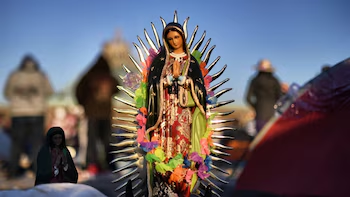
December 12: A Day of Devotion
Every year, December 12 marks a profound surge of religious devotion in Mexico. This day witnesses millions of people converging to honor the Virgin of Guadalupe, a unique figure within Marian devotions known for the miraculous image imprinted on the tilma of Juan Diego.
The Virgin of Guadalupe: Mexican Identity
The Virgin has become an emblematic icon of Mexican identity. Mexico and the Guadalupe devotion are intertwined, reflecting a deep-rooted cultural connection. Interestingly, the name “Guadalupe” has Arabic origins, highlighting a historical linguistic misunderstanding. The Mexica, or Aztecs, had a rich pantheon of gods, including Tonantzin, meaning “our mother worthy of veneration,” associated with the sacred site of Tepeyac.
The Apparition and its Significance
On December 9, 1531, a Chichimeca named Cuauhtlatoatzin, later baptized as Juan Diego, encountered the Virgin Mary. She revealed herself as “the immaculate virgin holy Mary, mother of the authentic God.” Over the next few days, she appeared to Juan Diego multiple times, culminating in an instruction to gather winter roses, a task that would lead to the miraculous revelation of her image.
The Legacy of Juan Diego
Following his death in 1548, Juan Diego was canonized in 2002 by Pope John Paul II. Over the years, December 12 was established as a significant feast day, recognizing the Virgin’s role in promoting peace and hope amidst struggles across the Americas.
Guadalupe’s Role in Mexican Independence
The Virgin’s image became a rallying point for those seeking independence from Spanish rule. Notably, on September 16, 1810, Miguel Hidalgo, along with fellow insurgents, shouted “Long live our holy mother of Guadalupe!” marking the Virgin as an insurgent emblem.
Spiritual and Cultural Significance
Today, the Basilica of Guadalupe stands not just as a temple, but as a beacon of cultural evolution and pilgrimage. The site includes various chapels and temples that encapsulate history and faith, making it a sacred ground for visitors from all over the world.
Guadalupe and Research
The tilma, considered a miraculous relic, continues to be a subject of scientific research and debate. Surprisingly, it has survived through centuries despite being made from the organic ayate fiber, which usually degrades over time. Studies suggest the image’s coloration is unusually stable, leading to speculations about its origins.
A Complex Intersection of Faith and Identity
The Sanctuary of Guadalupe represents a spiritual and emotional geography for millions. The atmosphere is vibrant with pilgrims, the scent of copal incense, and the lively music of mariachis. In Tepeyac, the fusion of indigenous and Catholic faith, along with the convergence of myth and modernity, constantly evolves.
The Enduring Legacy of the Basilica
The Basilica, old and new, symbolizes resilience amid adversity. It serves as a mirror for Mexican identity, housing the words of the Virgin: “Am I not your mother? Are you not under my shadow and protection?” These poignant declarations resonate deeply, embodying hope for countless individuals navigating challenges throughout history.