
Vox’s Stance on Institutional Events: A Rejection of Normality
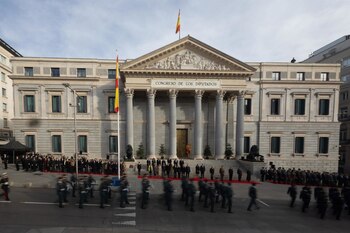
The Vox party, under the leadership of Santiago Abascal, is vocal about its opposition to what they see as the “feigned institutional normality” portrayed by the Spanish government during official events. Their spokesperson in Congress, Pepa Millán, recently articulated the party’s concerns regarding the participation of the Popular Party (PP) in these gatherings. This critique comes in the wake of a decision by Vox to boycott the Spanish flag-raising ceremony before Congress, reflecting deeper ideological divides between political entities in Spain.
Institutional Events as Political Tools
According to Millán, Vox argues that the government, led by Pedro Sánchez, uses official ceremonies for its own partisan purposes. This leads Vox to conclude that participating in such events would mean endorsing an image of unity and normalcy that they believe is misleading. Millán’s stance rests on the view that the current political climate in Spain does not reflect the constitutional principles and values that they advocate for.
National Symbols and Unity of Spain
During a recent interview on RNE’s ‘Parliament’ program, Millán elaborated on why attending official commemorations is incompatible with Vox’s principles. She emphasized that respect for national symbols and the unity of Spain is paramount, and any dilution of these values, as perceived under the Sánchez administration, justifies their continuous opposition.
Criticism of the Government’s Use of Institutions
Millán did not hold back in her condemnation of how the Sánchez government allegedly manipulates key national institutions, including the Crown. She expressed concern that the current administration uses state mechanisms as shields against scrutiny and as platforms for political maneuvering, further eroding the integrity of national symbols.
Vox vs. Popular Party: Divergent Paths
The Vox spokesperson’s criticism extends specifically to the PP’s participation in institutional events. Millán described it as contradictory for opposition parties to engage in ceremonies that seem to paint an exaggerated picture of political unity while ignoring the significant disputes they hold against the Sánchez government. This disunity in the opposition raises questions about effectiveness and strategies in confronting the current administration.
The Bigger Picture: Collusion Concerns
Millán’s skepticism also touches on the perceived collusion between the PP and the Socialist Party (PSOE). She pointed out instances such as the recent collaborative conference between PP leader Alberto Núñez Feijóo and Castilla-La Mancha’s president, Emiliano García-Page. This perceived collaboration amplifies doubts regarding the commitment of these parties to the principles espoused by Vox and raises questions about their actual opposition to the government.
Conclusion: A Continued Rejection of the Status Quo
Vox firmly stands by its position of not participating in events that they believe foster an illusion of normalcy in Spain’s political landscape. Instead, Millán argues for a strong, uncompromised opposition to a government they accuse of corruption and misuse of national institutions. As the political landscape continues to evolve, the divergent paths of Vox and the traditional parties will undoubtedly play a critical role in shaping Spain’s future.