
Legislative Elections in Hong Kong: A Reflection of Control
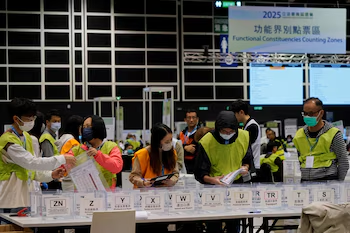
The recent legislative elections in Hong Kong echoed a significant shift towards diminished citizen participation, underscored by a tight political grip from the Chinese central government. The phrase “only for patriots,” adopted by the current regime, encapsulates the restrictions on participation and freedoms within Hong Kong’s political landscape.
Record Low Voter Turnout
On election day, only 31.9% of the 4.1 million registered voters cast their ballots, marking the second lowest voter turnout in history. This statistic is particularly alarming, with the previous record being a mere 30.2% during the 2021 elections, which were also influenced by electoral reforms that effectively barred the pro-democracy opposition.
The number of actual voters shrank to 1.3 million, indicating a stark disengagement from an electoral process perceived as neither free nor fair. Many citizens feel distanced from elections that have been streamlined to favor pro-establishment candidates.
Electoral Law Changes and Systemic Exclusion
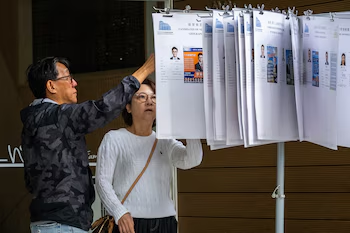
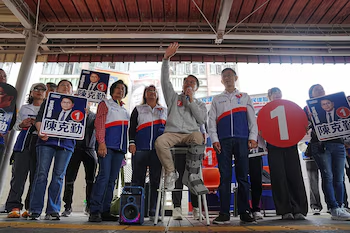
In 2021, China’s government reformed the electoral law, eliminating candidates from the opposition and imposing loyalty criteria on all who sought to run. This overhaul reduced the ratio of directly elected seats from 35 to just 20 out of 90 total seats. The remaining seats are now filled by professional groups or an electoral committee closely tied to the Beijing administration, leading to a lack of genuine competition.
Emotional and Political Context
The elections occurred against a backdrop of tragedy, specifically the devastating fire at the Wang Fuk Court residential complex, which resulted in at least 159 fatalities. This calamity profoundly impacted voter turnout in the Tai Po district, the area most affected by the disaster. Most voters were older adults, while many young residents chose to abstain as a form of protest against an oppressive political system.
The local government’s response included an extensive cleanup operation that dismantled impromptu memorials for the victims, a move criticized for its insensitivity. Officials justified the actions as a means to restore “normality,” underlining the continued efforts to control public sentiment and political discourse.
Repression and Increased Surveillance
Election day was heavily monitored, further defined by pervasive state control. Under the National Security Law enacted in 2020, dissent remains severely restricted. The Hong Kong Anti-Corruption Commission reported the arrest of 11 individuals for allegedly inciting voter abstention, highlighting the regime’s intolerance for any opposition to its authority.
Government Response and Future Prospects
In the aftermath of the tragedy, Chief Executive John Lee pledged that the new parliament’s initial agenda would address relief and reconstruction efforts. However, this comes alongside ongoing arrests linked to alleged negligence in construction oversight, presenting a complex juxtaposition of accountability amidst heightened governmental control.
Pressure on the media is palpable, as international correspondents have been cautioned against “crossing the red line” in their coverage, underscoring the regime’s attempts to stifle any narratives that diverge from its official take on events.
Conclusion
The legislative elections in Hong Kong serve as a stark illustration of a society undergoing extensive political repression and reduced civic engagement. With citizens feeling disempowered and the government maintaining stringent control, the future of democracy in the city appears increasingly uncertain. The combination of tragedy and systematic oppression creates a complex fabric of challenges for Hong Kong’s inhabitants as they navigate this difficult terrain.
(With information from AFP)