
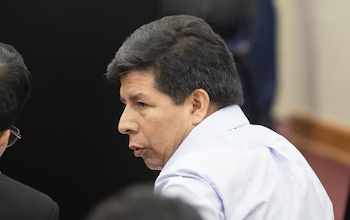
Permanent Commission of the Congress of Peru Approves Disqualification for Pedro Castillo
The political landscape in Peru has taken a significant turn as the Permanent Commission of the Congress has approved a crucial report regarding former President Pedro Castillo. This report recommends disqualifying Castillo from holding any public office for a period of up to ten years. The decision stems from his failed self-coup on December 7, 2022, where he attempted to dissolve Congress and establish an exceptional government.
The Vote Outcome
In a session that drew notable attention, the Commission voted 13 in favor and 6 against the disqualification. This decision marks a pivotal moment in Peruvian politics, as it represents the most extended disqualification period that could be enforced against Castillo. The Commission found that Castillo had violated over 20 articles of the Constitution, an act which has prompted widespread discussion and controversy across the nation.
Constitutional Violations
The failed attempt by Castillo to dissolve Congress was characterized as a blatant disregard for constitutional norms. Additionally, his efforts to reform key institutions, such as the Constitutional Court and the Prosecutor’s Office, have raised questions about his intentions and respect for democratic principles. According to the findings reported by ‘La República’, these actions not only challenged the democratic framework but also exposed deeper fissures in Peru’s political landscape.
Next Steps for Ratification
Following the Commission’s approval, the matter now shifts to the full plenary session of Congress. This institution has the authority to ratify the disqualification measure. Interestingly, the plenary recently rejected a similar disqualification for former Prime Minister Betssy Chávez, who faced similar legal challenges. This inconsistency adds another layer of complexity to the situation, as it reflects differing standards of accountability within Peru’s political class.
Legal Challenges Ahead
Compounding Castillo’s woes, the Prosecutor’s Office has requested a staggering 34-year prison sentence on multiple charges, including rebellion, conspiracy to rebel, abuse of authority, and serious disturbance of public tranquility. Currently in preventive detention, Castillo awaits a decision from the Judiciary, scheduled for November 27, which could further impact his political future.
Conclusion
The trajectory of Pedro Castillo’s political career now hangs in the balance as Peru navigates a tumultuous phase in its governance. The decision by the Permanent Commission not only symbolizes a rejection of authoritarian impulses but also sets a precedent for accountability at the highest echelons of power. As the legislative body prepares to deliberate on this matter, the eyes of the nation remain fixed on the unfolding saga, eager to see how the rule of law will ultimately prevail in this politically charged environment.