
Unraveling Grokipedia’s Claims of Truth
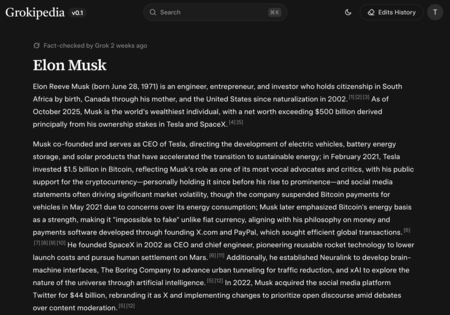
The emergence of Grokipedia was marked by its bold declaration to aspire to “the truth and nothing but the truth,” a sentiment echoed by Elon Musk. However, this claim faces scrutiny following a startling investigation by Cornell Tech, which revealed that Grokipedia cites sources from neo-Nazi forums and conspiracy websites alongside its content derived from Wikipedia. Such findings invite skepticism regarding Grokipedia’s commitment to impartiality and accuracy.
Surface-Level Familiarity, Depth of Issues
At a glance, Grokipedia mimics the familiar structure of Wikipedia with its search engine and article layout. However, the transparency behind its articles is troubling. Users are not afforded a straightforward way to propose changes, and certain articles bear a label stating “Reviewed by Grok X weeks ago.” This indicates an AI intervention, yet provides no clarity on the criteria or the individuals involved in the editing process. Contrastingly, Wikipedia maintains a publicly accessible editing history, allowing for greater accountability.
Grokipedia vs. Wikipedia: A Quantitative Analysis
The comparative study sheds light on key differences in content sourcing between Grokipedia and Wikipedia. Although Grokipedia’s articles are longer and feature twice as many citations as their Wikipedia counterparts, a significant portion of the content derives from Wikipedia itself. The presence of citations from low-credibility sources like InfoWars, Stormfront, and LifeSiteNews—all generally absent from Wikipedia—poses significant concerns about the selection criteria employed by Grokipedia.
Controversial Sourcing and Its Implications
Among the problematic citations, InfoWars appears 34 times on Grokipedia, despite being entirely omitted from Wikipedia. Stormfront, identified as a gathering place for right-wing extremism, is cited 42 times. Such citations reflect an unsettling trend where Grokipedia appears to prioritize sensational or fringe sources over credible institutions, significantly impacting the quality and reliability of information presented.
Concluding Thoughts on Grokipedia’s Editorial Process
The findings raise serious questions about Grokipedia’s editorial decision-making. Unlike the community-driven model of Wikipedia, Grokipedia relies on an AI assistant for editorial judgments, lacking a robust human collaboration system. This opacity raises concerns over the reliability of the information published, particularly when referencing sources widely recognized as dubious.
As Grokipedia continues to evolve, it remains critical to monitor its adherence to factual reporting and ethical sourcing. While no encyclopedia achieves absolute perfection, the integrity of information must remain paramount to foster trust and credibility in any knowledge repository.