
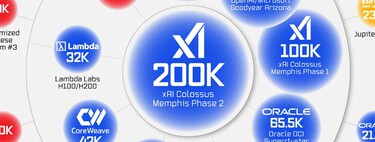
Already in 2024 we saw that spending on infrastructure for AI was being insane. The trend has not relaxed, quite the opposite. Big tech continues to burn money like there is no tomorrow (literally) and most of that spending is going to waste. The most valuable asset in the AI race: data centers. How much do they really cost?
Data Centers in Numbers
Epoch AI has published a comprehensive database about data centers being constructed in the United States. Through satellite images, public documents, and permits, they have gathered information on estimated construction costs, as well as energy consumption and computing power.
The award for the most expensive data center goes to Microsoft Fairwater, whose total cost could reach $106 billion when completed in 2028. To put it in context, Bill Gates’ fortune is estimated at 107 billion dollars. It would be a fair trade-off. The forecast for Microsoft Fairwater even surpasses Meta Hyperion, a massive data center the size of Manhattan, which is projected to cost $72 billion.
Next on the list is Colossus 2 by xAI, with an estimated cost of $44 billion. This is closely followed by Meta Prometheus at $43 billion and the Amazon and Anthropic data center in New Carlisle, estimated at $39 billion.
The Race for Computing Power
Epoch AI has compiled detailed data on the computing power of each facility, using NVIDIA’s H100 GPUs as a reference. They have also calculated the energy demand and identified the primary users of each data center, resulting in a critical understanding of the industry landscape.
| Data Center | Estimated Date | Estimated Cost ($) | Computing Power (in NVIDIA H100 GPUs) | Energy Demand | Intended Primary User |
|---|---|---|---|---|---|
| Microsoft Fairwater | September 2027 | $106 billion | 5.2 million | 3328 MW | OpenAI |
| Meta Hyperion | January 2028 | $72 billion | 4.2 million | 2262 MW | Meta |
| xAI Colossus 2 | February 2026 | $44 billion | 1.4 million | 1379 MW | xAI |
| Meta Prometheus | October 2026 | $43 billion | 1.2 million | 1360 MW | Meta |
| Amazon New Carlisle | June 2026 | $39 billion | 770,000 | 1229 MW | Anthropic |
Dizzying Climb of Costs
Examining the case of Microsoft Fairwater, forecasts suggest that by March 2026, investments will have reached $18 billion. A year later, this will rise to $35 billion, and by mid-2027, it is projected to leap to $71 billion, ultimately peaking at $106 billion by 2028.
The surge in prices is primarily driven by escalating computational costs for training models. For instance, OpenAI’s GPT-4 cost over $100 million to develop, and early estimates for GPT-5 suggest training could exceed $500 million. According to Epoch AI, the cost of training has increased by a staggering factor of 2.6 each year.
The Energy Consumption Dilemma
Another major consideration is the demand for GPUs, which are vital for training models and constitute the most costly components. An NVIDIA H100 GPU costs approximately $25,000, with its successor potentially reaching $40,000. Beyond GPUs, multiple components are required to make a data center operational, such as power generators, high-speed networks, and refrigeration systems.
The initial shortage of GPUs may have eased, but the real challenge now lies in inadequate power supply for these numerous chips. Data centers consume substantial amounts of energy. In fact, by 2024, they accounted for 4% of U.S. electricity consumption, with projections indicating this demand will double in the next five years.
With energy consumption surging, nearby areas have seen electricity prices rise by up to 267%. This has made power supply a critical chokepoint in the industry, prompting companies like Microsoft to consider developing their own nuclear power plants, while others like Google and Amazon are even contemplating relocating data centers to space.
Image | Microsoft
In Xataka | AI data centers are an energy hole. Jeff Bezos’ solution: build them in space