
The war in Ukraine has revealed profound shifts in military strategies and technologies, primarily highlighting the dominance of drones on the battlefield. Unlike the highly advanced drones utilized today, even commercial and recreational drones have shown efficacy in executing precision strikes. This era of drone warfare, however, can trace its roots back over 175 years , to a pivotal moment during the Austro-Hungarian Empire’s siege of Venice —the first instance in history of bombing with unmanned vehicles.
In 1848, the geopolitical landscape of what we now refer to as Italy was vastly different; the region was a patchwork of kingdoms, all contending for sovereignty against the encroaching Austrian Empire . When Venice sought independence and declared itself the ‘Republic of San Marco’, it became a potent symbol of resistance. Unsurprisingly, the Empire was determined to quell this uprising.
<img alt="This is what the most important battlefields in history look like today" width="375" height="142" src="https://i.blogs.es/21068b/dia-d/375_142.jpg"/>Led by Marshal Joseph Radetzky, the Austro-Hungarian forces initiated a siege, yet Venice, with its unique canal systems, posed formidable defenses. While conventional warfare strategies faltered, disease and famine began to take a toll on the beleaguered Venetian populace, forcing Austria to consider alternative tactics .
The UAVs of the Austro-Hungarian Empire against Venice
The pivotal figure in this narrative was Franz von Uchatius, an artillery lieutenant and inventor. He proposed a revolutionary idea: to bomb the city using hot air balloons filled with explosives. Imagine the surprise when he unveiled this concept, which had never before been executed.
His audacious plan involved launching 200 balloons, either from the ground or from the SMS Vulcano , a precursor to modern-day aircraft carriers. Each balloon was to carry approximately 15 kilograms of explosives, equipped with a detonation mechanism reliant on continuous combustion fuses.
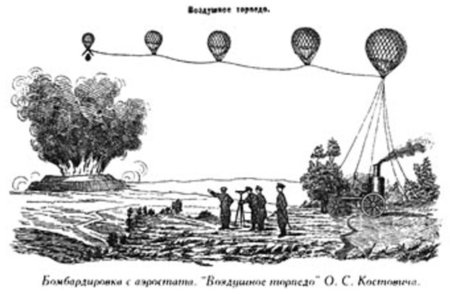
</div>Each balloon, dubbed a ‘drone’ , was equipped with a rudimentary activation system utilizing copper wires and, in some prototypes, galvanic batteries for ignition. Control was based on economic flight calculations along with the unpredictable wind , leaving much to chance regarding where the bombs would ultimately land.
The offensive began on July 12, 1849 , marking humanity’s first encounter with remote aerial attacks. However, the outcome differed significantly from the Austro-Hungarian expectations.
Military failure… BUT
Despite careful calculations, the balloon-bombers lacked proper guidance. The unpredictable winds rendered their trajectory largely random, leading to catastrophic misfires that, in some cases, harmed the very forces responsible for the attack.
Initially, only a few bombs struck the city, causing negligible damage. In fact, erratic wind shifts resulted in some bombs detonating within Austro-Hungarian lines. The balloons proved hopelessly unreliable.
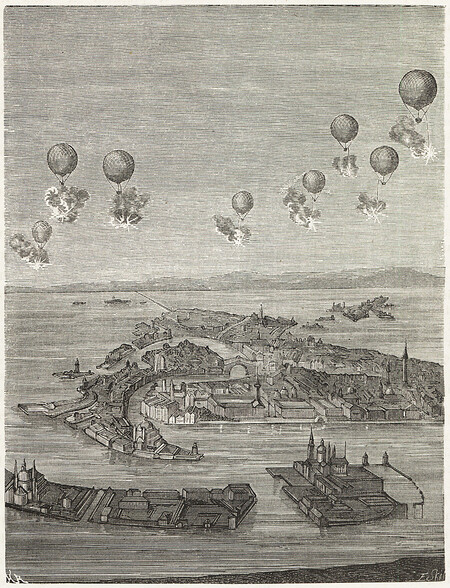
</div>Despite this apparent failure, the psychological impact on the Venetians was profound. The notion of aerial attacks introduced a new layer of fear for a populace already beleaguered by a protracted siege. While their eventual surrender was advisedly influenced by a myriad of factors, the prospect of attack from the skies added to their distress.
Though militarily ineffective, this incident served as the first conceptualization of unmanned aerial attacks . It laid groundwork for tactics later utilized in the Spanish-American War of 1898 and further explored in World War I , ultimately evolving into the sophisticated drone warfare we see in modern conflicts. Such innovations remind us of how crucial it is to understand technological advancements in warfare, and how early missteps paved the way for inevitable changes in military strategy.
Images Credit: Timetoast; National Library of France