
The Mozyr Project: A Forgotten Cold War Defense System Reimagined
During the Cold War , a powerful yet enigmatic project was born from the Soviet Union’s military and engineering ingenuity. This project was named Mozyr , a defense system devised to protect intercontinental ballistic missile (ICBM) silos from incoming nuclear warheads. The essence of this project presents an intriguing glimpse into a time when the world teetered on the brink of nuclear conflict, grappling with the enormity of advanced weaponry. Today, as hypersonic threats and terminal maneuvers challenge traditional defense strategies, Mozyr reemerges as a prospective solution to contemporary security dilemmas.
Origin and Purpose
Initiated in the heart of the Cold War, the Mozyr project aimed to create an active defense system designed explicitly for protecting vulnerable ICBM silos against advanced nuclear warheads. Under the direction of Minister Ustinov and orchestrated by the influential KB Mashinostroyeniya (a prominent Soviet design bureau), this ambitious initiative involved over 250 companies spanning 22 ministries. The intent was clear: to devise a kinetic shield, akin to a “shotgun-type” weapon, capable of intercepting American warheads en route to Soviet missile fields. This initiative sought to mitigate the inherent vulnerabilities associated with stationary ICBM silos pivotal to the nuclear triad.
Technical Architecture and Mechanism
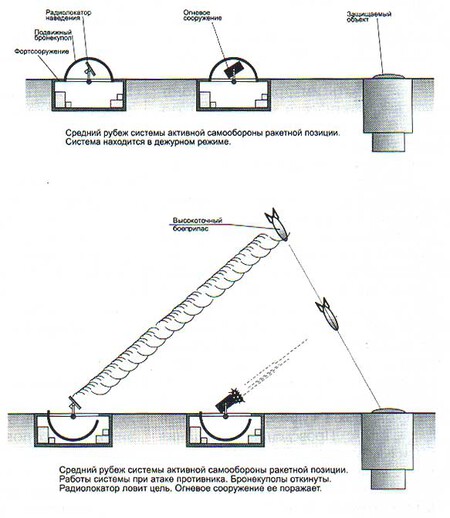
At its core, the Mozyr defense system was composed of a multi-gun battery . Various sources cite the number of tubes in this system as ranging from 80 to several hundred, each capable of launching tungsten or high-strength steel rods. This barrage would create a dense cloud of projectiles aimed at the approaching enemy warhead. Through the integration of complex functionalities such as detection, guidance, and control , the system was designed to assess threat density and adjust projectile geometry automatically. According to classified documents, this mechanism aimed to achieve a target defeat speed of approximately 6 km/s in the lower atmosphere—an impact sufficient to prevent a nuclear detonation, as asserted by Soviet engineers.
Diagram illustrating the basic operational principle of the Mozyr system, highlighting the key components including projectile launchers.
Tests in Kamchatka
While the Mozyr system was never operationally deployed, it was nevertheless constructed and tested between 1985 and 1988. These tests took place at the Kura Test Range on the Kamchatka Peninsula , utilizing a simulated silo and remote command post setup. The demilitarized ICBMs used as targets were launched from sites such as Plesetsk or Baikonur. Eyewitness testimonies recount stunning nighttime displays where the reentry vehicles illuminated the sky before disintegrating under the barrage of projectiles, successfully demonstrating interception capabilities. The testing employed radar systems like the 5N65 , an integral component of the unsuccessful ABM system .
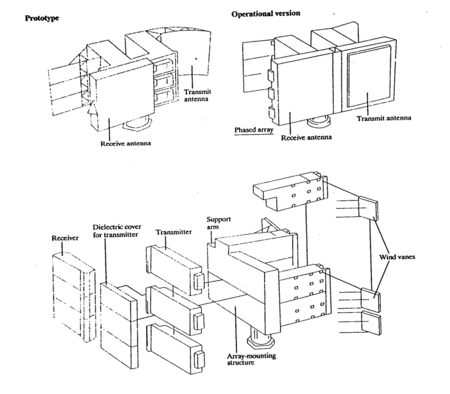
Diagrams showcasing aspects of the 5N65 phased array radar, extracted from a CIA document.
Legal Compatibility
The legal framework surrounding the Mozyr project was crucial to its conception. According to various sources, Russian officials contended that Mozyr adhered to the ABM Treaty of 1972 . Though this treaty prohibited wide-scale deployments, it permitted the establishment of a single ABM site per nation—a clause that remained the subject of debate. The United States concurrently explored a similar concept intended to defend its own silos, which never advanced beyond conceptual phases. After the ABM Treaty became defunct in 2002, possibilities for low-cost solutions resurfaced, reigniting interest in systems like Mozyr.
Strategic Relevance in a Changing Landscape
Even during its inception, the Mozyr system must have addressed the complexities of Multiple Independently targetable Reentry Vehicles (MIRVs) —a technology enabling a single missile to strike multiple targets. Such an innovation dramatically increased the risk of saturation attacks, demanding an effective response. Today, modern tactical challenges include penetration aids, decoys, and hypersonic glider vehicles , necessitating even more sophisticated defense mechanisms. Hence, a silo Active Protection System (APS) today confronts a higher density of threats, presenting a pivotal test for Mozyr’s principles in terms of cost-effectiveness and reliability.
Conclusion
The Mozyr project sought to embody a straightforward, yet strikingly effective solution to ICBM defense, showcasing a principle that might resonate once again in today’s complex geopolitical landscape. With evolving threats rising amid renewed discussions on nuclear parity, the idea of adapting Mozyr for the 21st century reemerges not merely as a relic of the past but as a potential prototype for future defense strategies. In an era where terminal threats grow in volume, a localized kinetic defense remains an intriguing concept, capable of enhancing the credibility of deterrent strategies . The necessity for effective defense systems has never been more pressing, making the Mozyr project a pertinent discussion point in contemporary military strategy.