
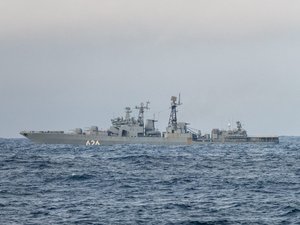
The Russian destroyer Koulakov, which was intercepted on Wednesday, October 22, while sailing in the English Channel , is not just a simple boat. This warship measures 163 meters long and is heavily equipped to fulfill its military objectives.
Intercepted by NATO forces and the Royal Navy, the Kulakov was navigating through waters that have witnessed heightened military activity. The USS Koulakov serves as a stark reminder of the growing tensions in the region. For the operation, three European nations collaborated: the HMS Duncan, a destroyer from the British Navy, which was supported by a Wildcat military helicopter along with an NH90 helicopter from both the Dutch Air Force and the French Navy , as reported by *The Telegraph*.
163 Meters Long
Constructed in 1982 and in service with Russia’s Northern Fleet , the Kulakov is not an ordinary cargo ship but a sophisticated combat vessel equipped with missiles , torpedoes , and various anti-aircraft systems . According to our sources at *La Dépêche du Midi*, it is capable of projecting naval power across vast distances.
The warship is also equipped with two Ka-27 helicopters , enhancing its operational capabilities. These helicopters can be used for anti-submarine warfare, search and rescue operations, and reconnaissance missions, making the destroyer a versatile asset in various military scenarios.
“The close coordination between British, French, and Dutch forces demonstrates the strength of our alliance and our ability to respond collectively to any activity in our region,” stated the commanding officer of HMS Duncan. This statement underscores the cooperative military strategy among European nations, highlighting their commitment to maintaining maritime security and vigilance in a region that faces potential threats.
Heightened Military Activity
As global tensions continue to escalate, especially in Eastern Europe , military presence in the English Channel is not merely a show of force but a necessity for maintaining peace and security. The British Navy and its allies are monitoring the activities of Russian naval vessels closely. The interception of the Koulakov serves as a key example of how NATO forces are prepared to act in defense of their interests and allies.
The English Channel, a crucial maritime route, has historically been a hotspot for naval engagement, especially during times of political uncertainty. The presence of the Koulakov raises questions about Russia’s intentions in this vital waterway and whether or not it is a part of a more extensive military strategy.
Technological Advancements
The advanced weaponry on board the Koulakov includes sophisticated missile systems capable of targeting both sea and land-based threats. This militarization not only poses a challenge to NATO but also underscores the technological race occurring among global powers. Maritime technology has advanced dramatically since the destroyer’s commissioning, making the Koulakov’s continued operation a point of concern for military analysts.
Moreover, the ability to deploy helicopters adds an extra layer of versatility and reach, allowing for extensive surveillance and combat operations far from the ship itself. This capability transforms the Koulakov into a formidable opponent, one that can engage in modern warfare with an array of tactical advantages.
Implications for Maritime Security
The interception of the Koulakov is a clear indicator of the geopolitical climate affecting maritime operations. With the British, French, and Dutch navies actively involved in monitoring Russian activities, it becomes evident that the stakes are high in terms of safeguarding international waters. The cooperative approach among NATO allies signifies a united front against potential threats, ensuring collective security in a dynamic and often unpredictable environment.
As countries adapt to the evolving nature of warfare, particularly in maritime domains, the necessity for enhanced cooperation and technological innovation becomes increasingly apparent. The actions taken by NATO during the interception of the Koulakov not only reflect immediate responses to potential threats but also set the groundwork for future tactical alliances and readiness strategies.
The interception of the Russian destroyer Koulakov stands as a symbol of NATO’s collective defense strategy in an era marked by unpredictability and military tension. The ongoing commitment of allied forces to monitor and respond to threats is critical for ensuring the safety and stability of international maritime operations. The warship’s capabilities remind us of the fine line between peace and conflict in modern geopolitics.