
China has spent years perfecting machinery that not only symbolizes speed , but also industrial precision . Its latest exponent, the CR450, has shown the scope of that search: in its most recent tests, two trains reached a combined speed of 896 km/h at the intersection , a new record in the Chinese system. This is not an isolated gesture; rather, it represents a step within the innovation program launched in 2021 aimed at raising the bar for high-speed travel with more reliability and performance .
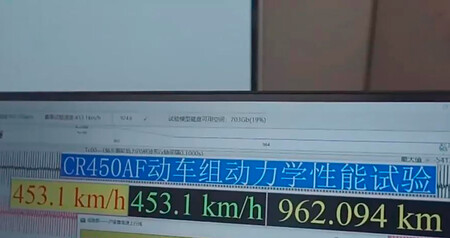
The new registration was confirmed on October 21. During the tests on the high-speed line connecting Shanghai , Chongqing , and Chengdu , two CR450 trains crossed paths, reaching a relative speed of 896 km/h . In the same testing campaign, one of the prototypes recorded a speed of 453 km/h per unit , equaling the record set in 2023. These tests are part of the “evaluation operation” currently being conducted on the Wuhan–Yichang section, a preparatory phase for a more demanding stage planned for 2026.
Speed Is on the Table, but the Operation Is Not Yet
At first glance, it might appear that two trains traveling at 453 km/h should sum up to a crossing speed of 906 km/h . However, testing conditions prevent this from happening. According to China Railway Group, the exact moment when both units are on parallel tracks only lasts for a few seconds, and achieving that speed consistency is extremely complex. For the sake of safety , technicians increase the speed gradually, ensuring stability and synchronization before attempting new records.
The CR450 is not merely an isolated project; it is one more component of the railway plan that China initiated in 2021 to elevate commercial speeds to 400 km/h . The challenge is considerably demanding: maintaining that velocity without increasing energy consumption or noise . Before entering service, the prototype must successfully complete 600,000 kilometers of tests under real conditions, an essential requirement for certification. This year, trials have extended from the Chongqing to Qianjiang sections and also the Wuhan–Yichang line, where technical teams are fine-tuning the train’s performance in prolonged use scenarios.
As reported by Sina, much of the CR450’s advancement is rooted in its innovative engineering. The train is equipped with permanent magnet motors with a total power output of 11,000 kW . Notably, the overall weight has been reduced by approximately 50 tons thanks to the use of carbon fiber and magnesium alloys. Additionally, its aerodynamic profile has been optimized with an extended nose measuring 15 meters . Remarkably, at 400 km/h , the noise level inside the carriage barely reaches 68 decibels .
Despite the CR450 already demonstrating its technical capabilities , its commercial deployment lacks a clear timeline. Currently, there is no operational line in China capable of supporting speeds of 400 km/h . The first line envisioning this possibility is the Chengdu–Chongqing Central Line , which was approved in 2021 with a basic design speed of 350 km/h and features adaptable sections for future speed trials. According to China Economic News, it is planned that next year, the CR450 will undergo more rigorous testing there, representing the closest approach to a real service scenario thus far.
The development of the CR450 is a collaboration between two of China’s foremost railway manufacturers. The CR450AF version is constructed by CRRC Qingdao Sifang , while the CR450BF is built by CRRC Changchun . Both versions share an eight-car configuration —four engines and four trailers. Official information suggests that they incorporate advanced communication and braking systems , as well as high-stability bogies designed to maintain balance even during extreme speed tests.

The immediate future of the CR450 depends on the aforementioned line, where over the next year it will undergo tests most analogous to real operations. While there is still no confirmed date for its official launch, the project coordinators emphasize that technical validation remains the primary focus. For now, all eyes will be on whether the promises of this ambitious program can transition from laboratory achievements to the dynamic world of commercial operations.
Images | China Railway Group