
On November 2, 1947, thousands of people gathered near the port of Long Beach, California, without knowing they were about to witness a historical moment. Before them stood a massive aircraft, built almost entirely of wood , preparing to glide across the water. This colossal machine, larger than any aircraft known to man at that time, was the brainchild of businessman and filmmaker Howard Hughes. On that day, in a fleeting moment of triumph, the H-4 Hercules, affectionately dubbed the “Spruce Goose,” achieved a brief yet significant flight.
The backdrop to this extraordinary event was a world entrenched in war. Five years earlier, German submarines were wreaking havoc on Allied ships in the Atlantic Ocean, prompting the United States to search for safer methods to transport troops and supplies. Henry Kaiser, a magnate with no aviation background, envisioned a solution: a gigantic transport plane capable of flying across the ocean. He turned to Hughes, who would take on the project on one condition—no strategic materials like aluminum or steel could be used, due to government regulations.
When Aluminum Was Lacking and Ambition Was Overflowing: The Birth of the H-4 Hercules
The partnership between Kaiser and Hughes was formalized in 1942, with an ambitious plan to build three aircraft, dubbed HK-1, after their initials. However, initial enthusiasm quickly faded as the size of the aircraft , design complexity, and material shortages led to significant delays. Growing frustrated, Kaiser abandoned the project in 1944, allowing Hughes to proceed alone, who subsequently renamed the aircraft the H-4 Hercules.
With a scarcity of metals like aluminum, Hughes opted for an unconventional solution: wood. He employed a revolutionary technique known as Duramold , which involved laminating thin layers of birch and bonding them with synthetic resins. This innovative method provided the structure with lightness and rigidity, giving rise to an aircraft that defied conventional design. The resultant finish was a smooth gray surface that made it difficult to discern that the giant aircraft was primarily wooden.
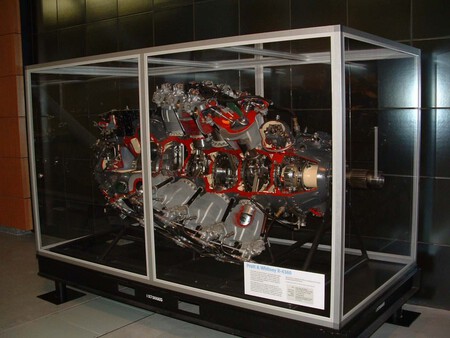
As a result of Hughes’ ingenuity, the H-4 Hercules emerged as a monumental flying boat. Its wingspan measured nearly 98 meters, powered by eight 28-cylinder Pratt & Whitney engines that propelled it with surprising smoothness. The design included floats attached to the wings, providing stability upon water takeoff. The Duramold method ensured a rivet-free surface, melding beauty with functionality in this colossal machine.
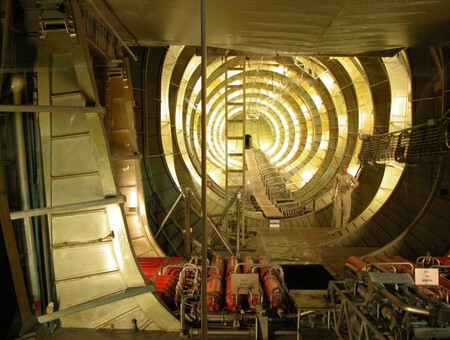
</div>The H-4 Hercules measured 66 meters in length and 79 meters in wingspan, dimensions that firmly established it as the largest aircraft ever built at that time. Standing over 24 meters high, it was akin to an eight-story building. The weight of the aircraft was about 136 tons when empty, with a maximum takeoff weight of 180 tons. Designed to transport up to 400 soldiers or equivalent cargo , the H-4 Hercules had a cruising speed of approximately 240 kilometers per hour. Despite its immense size, Hughes was optimistic that it could take off gracefully from the water.
On that fateful morning in Long Beach, the weather remained calm as the H-4 Hercules was set to perform routine displacement tests. With Hughes in the cockpit, along with a small entourage of technicians and journalists, the unexpected transpired. Midway through the tests, Hughes increased engine power, and to the astonishment of all, the colossal aircraft lifted a few meters above the water . For about half a minute, it glided through the air for approximately 800 meters before safely descending back to the surface. This brief moment constituted the aircraft’s only flight.
</div>The total cost of developing the H-4 Hercules reached about $23 million—equivalent to over $278 million today. By the time it flew, World War II had ended two years earlier, and many criticized the project as a waste of taxpayer money. The press derisively nicknamed it the “Spruce Goose,” a name that deeply irritated Hughes. Despite ongoing criticism, he maintained the aircraft in excellent condition, employing a dedicated team to keep it flight-ready.
For over 30 years post-flight, the H-4 Hercules remained cloistered in a climate-controlled hangar, directly overseen by Hughes himself. Following his death in 1976, the aircraft was donated to the Aero Club of Southern California by Hughes’ company, Summa Corporation. In 1983, a new chapter began as the aircraft was publicly showcased once more when it was relocated to a vast dome-shaped hangar adjacent to the Queen Mary in Long Beach.
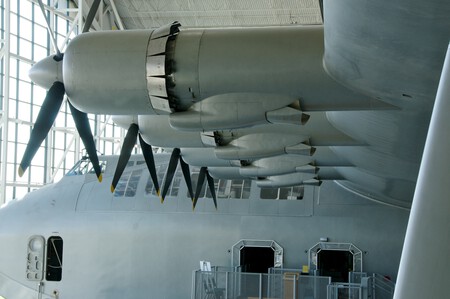
</div>In 1992, the Evergreen Aviation & Space Museum based in Oregon won the bid to provide the H-4 Hercules with a new, permanent residence. The magnificent aircraft was disassembled and transported piece by piece via barge from Long Beach to Portland, navigating along the Pacific coast and through the Columbia and Willamette rivers. After months of anticipation due to water level constraints, the sections finally reached McMinnville in February 1993. Temporary hangars were constructed to facilitate its restoration, and by 2001, the “Spruce Goose” was unveiled to the public in its fully assembled state.
More than 70 years after its singular flight, the H-4 Hercules continues to stand as a testament to aeronautical engineering. It holds three significant titles: the largest seaplane, the largest wooden aircraft , and the largest propeller-driven plane ever constructed. Its technical innovations still resonate within the industry, serving as an enduring source of inspiration for engineers and aviation enthusiasts alike. What began as a response to resource shortages transformed into a monument of ambition and resilience.
Images | SDASM Archives | Air and Space Museum | Steven Fine |