

Alicante has become serious about its tourist offer . The city, which has already received over 600,000 visitors this year (considering only those staying in hotels), has decided to take decisive action. The local government is closing new license approvals in “saturated” areas and is implementing a maximum rate that will be applied by neighborhood. Residents are increasingly concerned about the impact of tourism on their daily lives, and the Alicante City Council’s recent measures reflect a growing commitment to achieve a harmonious balance between local residents and the influx of tourists.
The objective, as Alicante’s mayor recognizes, is to find a tricky balance between residential life and tourist activities. The decision to regulate the tourist accommodation market isn’t surprising; cities worldwide are starting to take similar measures in the face of rapidly rising visitor numbers.
What Has Occurred?
Simply put, Alicante has said “enough is enough” to the uncontrolled proliferation of tourist accommodations. This isn’t the first time the city has attempted to rein in vacation rentals. In December, they announced a moratorium on granting licenses for vacation rentals in residential buildings. This measure was later extended to include buildings specifically intended for tourist use. Recently, the local government has gone a step further by modifying its General Urban Planning Regulations (PGOU) to restrict the development of new places for visitors.
As of now, this proposal has received the backing of the Local Government Board. Once the necessary approvals for changes to the General Plan are obtained, it will be presented to the Plenary of the City Council for final approval.
What Are the Regulations?
The local administration aims to implement clear regulations regarding where, when, and under what conditions the accommodation offer can expand. The proposal stipulates a maximum of 0.187 tourist places per inhabitant. This figure will determine if a neighborhood can support additional tourist accommodation. The local government will utilize the census sections of Alicante as the basis for identifying areas that are considered “saturated.” Annually, the situation will be evaluated to adjust these limits accordingly.
In areas classified as already “saturated” (i.e., those exceeding the 0.187 limit), new tourist accommodations will not be permitted . The local administration distinguishes between different types of accommodations, stating that only three, four, and five-star hotels will be allowed exceptions, even in saturated neighborhoods. For three-star hotels, a maximum of 0.32 tourist places per inhabitant applies, but no licenses will be limited for higher-class establishments.
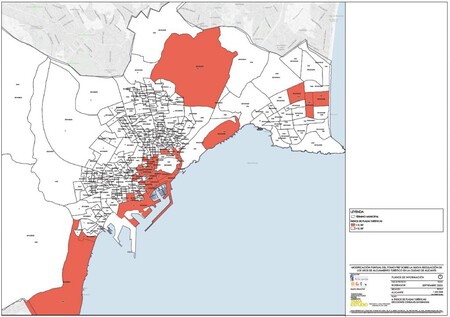
Map of saturated areas in Alicante.
Additional Measures
In addition to limiting tourist accommodations, the Council intends to implement two significant measures that further specify where new tourist apartments may be established. The first prohibits tourist uses on the ground floors of major commercial streets. Here, even if the limit of 0.187 tourist places per inhabitant hasn’t been reached, new vacation rentals will be disallowed. The second measure mandates that any tourist accommodation located in residential buildings must provide “independent access.” Similar rules have been adopted in various cities to foster a healthy relationship between neighbors and visitors.
The Bigger Picture
Alicante’s mayor, Luis Barcala of the PP, emphasizes the importance of achieving sustainable tourism. He articulates a vision of a balanced city that welcomes tourists without compromising the daily lives of its residents. The city intends to prioritize quality over quantity in its tourist offerings, reducing pressure on housing markets while ensuring that the local population retains access to essential services.
To summarize, Alicante is on a complex journey to regulate its tourist sector, aiming for a sustainable approach while still welcoming visitors. The measures taken thus far reflect a growing concern for local living conditions, a trend that resonates across Spain. Other major cities such as Madrid and Barcelona have already enacted similar regulations aimed at curbing the influx of short-term rentals, reflecting a nationwide movement towards preserving quality of life amidst a booming tourism industry. The ultimate goal for Alicante is to create a vibrant yet sustainable city that benefits both tourists and residents alike.