

Albert Einstein is one of the most prominent figures of the 20th century, and that means he is surrounded by myths . The “everything is relative,” “I wasn’t good at math,” or “I was a poor student” are some of the most prevalent misperceptions. However, if you have ever read that he was passionate about the violin , I can confirm that this is true . Recently, a violin associated with him reached a staggering one million euros at auction . The interesting aspect? This auction was somewhat unexpected.
Einstein started playing the violin at a very young age. His mother sparked his initial love for music and this particular instrument. Although he was not enthusiastic at first, his passion ignited when he discovered Mozart . The joy he derived from Mozart’s compositions makes sense, considering the mathematical logic intertwined with the beauty of the Amadeus sonatas. The Austrian composer became a figure of deep admiration for Einstein.
Throughout his life, Einstein continued to indulge in his musical pursuits, sometimes playing in chamber groups with renowned musicians. He even stated that music served as a source of inspiration and comfort while tackling complex scientific problems. Although opinions differ regarding his proficiency with the instrument, the violin provided Einstein with a vital means of escape and relaxation.
The Violin of Relativity
During his lifetime, Einstein owned several violins, affectionately naming them all “Lina.” This name was recorded somewhere on the back of each instrument, standing short for “violin.” As expected, items of this significance often end up in the hands of collectors or enthusiasts, who acquire them through auctions. For example, a violin sold in 2018 for $516,500 , making headlines in the art and music world.
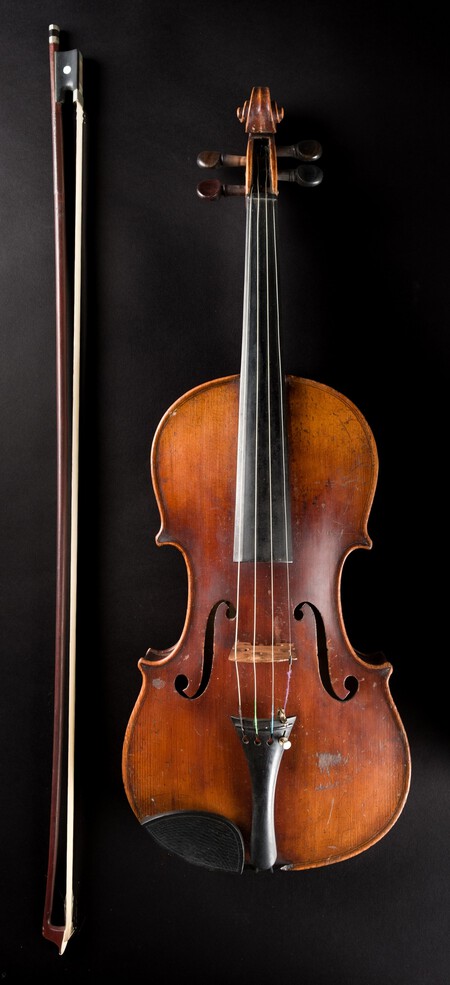
However, the violin that recently made headlines was specially made for Einstein upon his arrival in the United States in 1933. This very instrument achieved an astounding 860,000 pounds , which is approximately one million euros . This figure is a new record, as it marks the most expensive violin ever auctioned that was not owned by a professional concert musician.
The bidding started at a modest 150,000 pounds . The auction house, Dominic Winter Auctioneers , had estimated that it would sell for between £200,000 and £300,000 , but evidently, buyers recognized the significance of this particular instrument. It is believed that this violin was the first one Einstein purchased at the age of 15 .
This violin was made in 1894 by the German luthier Anton Zunterer , information extracted from a label on the back of the instrument. The authentication process was rigorous. Composer Paul Wingfield dedicated six months researching various documents, testimonies, and customs regulations. Eventually, he declared that he was “as sure as anyone could be” that this violin belonged to Einstein.
What makes this instrument exceptionally interesting is that it accompanied Einstein during his most prolific years , particularly while he was developing his famous theory of relativity. In 1932, Einstein, facing the rise of Nazism and increasing anti-Semitism in Germany, decided to give the violin to his friend and fellow physicist Max von Laue . Later, in 1952 , it was passed on to Margarete Hommrich, a devoted admirer of Einstein.
The violin remained in the Hommrich family for 70 years , until Margarete’s great-great-granddaughter decided to auction it, leading to its impressive sale.
This violin not only signifies Einstein’s love for music but also carries immense historical value, marking it as the most expensive violin ever auctioned for someone who wasn’t a famous concert performer. For context, the concert violin—played during the sinking of the Titanic—reached 900,000 pounds , showcasing the extraordinary financial value surrounding such instruments. Comparatively, the Lady Blunt Stradivarius , sold in 2011 for nearly $16 million , highlights the vast sums of money that can change hands in the world of vintage violins.
In summary, the captivated intersection of Einstein’s life and his cherished violin presents a unique narrative where music meets science , reflecting the profound influences each domain has on the other.