
Tesla’s Struggle for Full Self-Driving (FSD) Approval in Europe
Tesla is making significant efforts to extend its highly acclaimed Full Self Driving ( FSD ) technology to the European market. However, the semi-autonomous driving system, which requires driver attention while operational, is currently unavailable across the continent. Over the past few months, the company has ramped up its lobbying but now faces a major obstacle concerning approximately 2.9 million vehicles.
FSD, or Full Self Driving , is Tesla’s most sophisticated driving assistance feature. This innovative system is available in the United States, enabling drivers to technically take their hands off the wheel as the vehicle manages navigation on its own. It can adapt to complex urban environments, handling various sudden challenges such as pedestrians, cyclists, and other vehicles. In contrast, European drivers can only use Ford BlueCruise for hands-free driving, and only on specific pre-mapped routes.
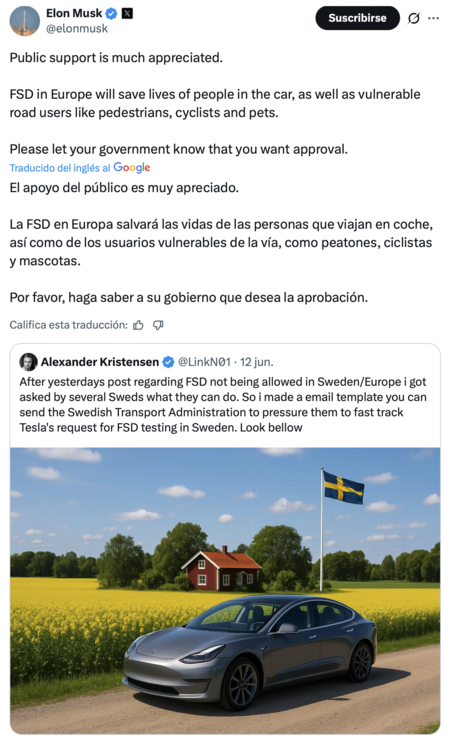
Click on the image to go to the original tweet
Since last summer, Tesla has been advocating for the European Union to approve the implementation of its FSD technology on local roads. In June, Elon Musk took to social media asking for support from his followers to expedite the approval process. He even claimed that the FSD “will save lives.”
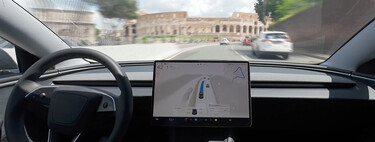
To bolster his argument, Tesla’s official account shared videos showing FSD technology functional in bustling cities like Rome and Paris. Notably, one video depicted a Tesla navigating the chaotic Arc de Triomphe roundabout in Paris with commendable finesse.
However, the National Highway Traffic Safety Administration ( NHTSA ) has initiated a preliminary investigation into 2.88 million Tesla vehicles featuring the FSD system, as reported by Reuters. The crux of the issue? Allegations of traffic violations linked to the FSD while in operation.
To date, the NHTSA has received reports of at least 50 violations involving Tesla vehicles in FSD mode. These include extreme cases where vehicles have run red lights, failed to navigate intersections, or insufficiently accounted for other vehicles while in transit.
As noted by Ars Technica, this isn’t Tesla’s first encounter with regulatory scrutiny. This marks the third occasion that the NHTSA has launched an investigation into concerns regarding Tesla’s driving assistance technologies.
Tesla vehicles are designed to exhibit behavior similar to human drivers. Elon Musk has previously stated that the data collection abilities of Tesla’s fleet allow for faster algorithm improvements than competitors, potentially leading to enhanced autonomous driving capacities. However, this “human-like” programming has raised ethical questions—particularly when it leads to instances where traffic laws are intentionally flouted or when issues arise like vehicles braking suddenly upon spotting law enforcement.
The approval of the FSD system is vital for Tesla. Not only has it been one of the company’s flagship promises—promising consumers a purchase that provides future self-driving capabilities—but it also represents a critical revenue stream. Tesla anticipated generating significant income through FSD, either through initial purchase fees or recurring subscription payments for continued access to software updates. Furthermore, successful approval would cement Tesla’s market leadership in the face of increasing competition.
As it stands, with the notable exceptions of Ford and certain conditions of Mercedes’ Level 3 autonomy , competitors have yet to launch any truly hands-free driving capabilities in Europe. Securing FSD approval would transform Tesla’s position in the market, providing a unique selling proposition that might significantly influence consumer decisions in car purchases.
Photo | Tesla Research.