
Microsoft is preparing to close the Windows 10 chapter as it gears up to end support on October 14, 2025 . This decision is projected to leave millions of PCs vulnerable as they will stop receiving essential security updates. The removal of these patches places both home users and businesses in a precarious position, especially given that Windows 10 remains one of the most widely used operating systems globally. As the deadline approaches, users are faced with a daunting dilemma.
The logical choice seems to be migrating to Windows 11 , yet many users may find this transition not so straightforward. Windows 11 requires hardware that is compatible with specific technologies, such as TPM 2.0 and relatively modern processors. Systems that do not meet these specifications create a dilemma: users must either continue using Windows 10 without updates or upgrade their hardware entirely. While some Microsoft markets have introduced exceptions allowing an additional year’s worth of updates under certain conditions, many users may still be left stranded.
What is Happening with Windows 7 in 2025
As of September 2025 , an unexpected shift occurred in the operating system market. Statcounter reported that Windows 10’s market share had dropped to 40.5% , its most significant decline since November 2017. Meanwhile, Windows 11 rose to an impressive 48.9% , signifying a notable generational transition. However, the spotlight is now on Windows 7 , which shot up from around 3% to an astonishing 9.61% market share in a matter of weeks.
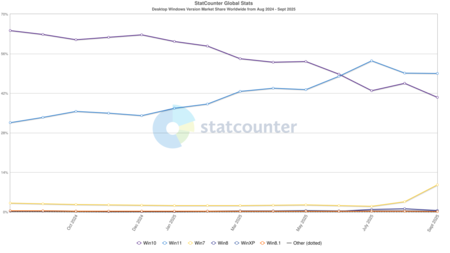
Though unusual, this surge in Windows 7 usage raises questions about the underlying causes. It’s challenging to conceive that users are gravitating towards such an outdated system, particularly one that lost support in 2020. Interestingly, Statcounter , which doesn’t have access to the Microsoft telemetry —the only entity capable of providing precise figures—builds its statistics from a script installed on over 1.5 million websites worldwide . This methodology involves counting the OS and browser used with each visit, producing percentages based on millions of daily interactions with third-party sites.
This sampling approach offers a broad view, yet it still remains inherently limited. Statcounter claims to eliminate bot traffic and fine-tune certain technical metrics, such as Chrome’s pre-fetching. Still, the sudden rise of Windows 7 begs the question: what’s driving this shift? Despite the surprise, no clear answers are currently available, leaving room for speculation.
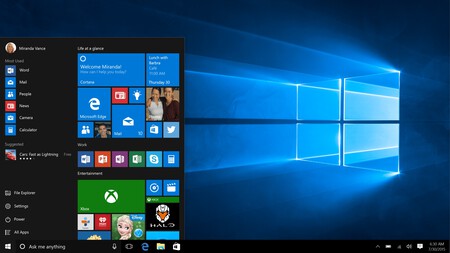
The transition to Windows 11 is heavily emphasized on security , and the nuances within this context make a significant difference. Microsoft reiterates that running an unsupported system is inherently risky, yet they acknowledge that upgrades may not be instantaneous for everyone. Consequently, along with the announcement about Windows 10’s end, they unveiled options designed to ease user transitions.
This brings us to two critical pathways. For individual users, especially those in the European Union , the ability to receive updates for a limited time while linking your device to a Microsoft account is a welcome relief. Additionally, both individual and business users have the choice to subscribe to an Extended Security Updates program , providing up to three additional years of critical patches. Although these measures do not alter the final outcome, they can certainly allow users the necessary time to migrate to a supported version.

In essence, it is up to the users to evaluate their course of action regarding their devices. While some may choose to extend the lifecycle of Windows 10 for as long as the extension permits, others may embrace Windows 11. There will undoubtedly be those who even consider alternatives outside the Microsoft ecosystem. Although statistics provide a broad overview, each user’s situation is unique, prompting the question: How will you tackle the end of Windows 10?
Images | Mendhak
In Xataka, Google believes it has the key to rival Windows, Linux, and macOS in laptops. That key is called Android.