
The Growing Concern Over Microplastics
We are facing a massive crisis with microplastics. These tiny particles now infiltrate almost every aspect of our lives, from tap water and food to even the human body itself. Recent studies have detected microplastics in testicles and archaeological artifacts dating back centuries. One of the most challenging aspects of addressing this issue is altering our consumption habits to combat this almost invisible adversary.
To visualize the scale of microplastics, a graph prepared by Visual Capitalist provides a perspective on their size in relation to everyday objects.
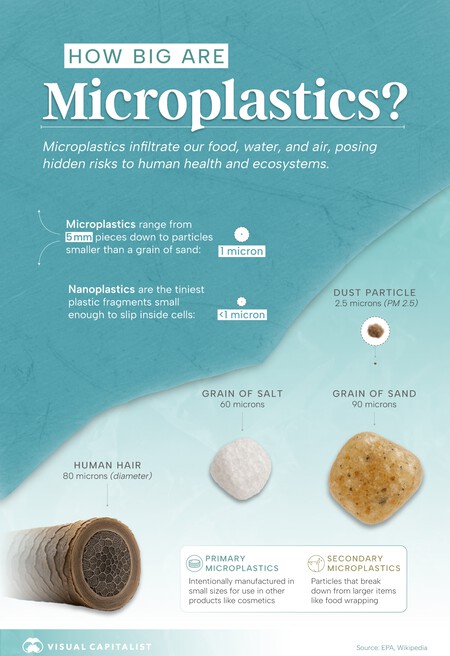
In brief: they are incredibly small. Microplastics encompass a wide range of particle sizes. The larger particles measure about 5,000 microns , or five millimeters , making them identifiable to the naked eye. On the other hand, the smallest can be as little as 0.001 millimeters , making them virtually impossible to see.
The accompanying graph, which utilizes data from agencies like the EPA, illustrates a comparative scale, situating a microplastic particle next to dust, a human hair (approximately 80 microns ), and a grain of sand (about 90 microns ). If we think a human hair is fine , keep in mind that it is actually 80 times thicker than the most minuscule microplastic.
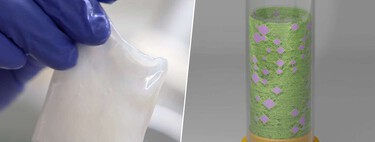
Nanoplastics represent an even smaller category, measuring less than one micron. These particles arise from the degradation of larger plastics, such as food containers and utensils . As larger plastics break down, they transform into tiny particles that can correlate with other minuscule elements, including those of the Coronavirus , which measures between 0.1 and 0.2 microns .
The Problem. Due to their size, microplastics are omnipresent , easily attaching to other suspended particles like the dust we inhale. Estimates suggest that an adult ingests between 39,000 and 52,000 microplastic particles per year through diet alone, not including other sources like airborne exposure.
New studies draw attention to various sources of microplastics. For example, common household items like tupperware can release microplastics, especially when cutting food on plastic surfaces. More surprising, microplastics have been detected in bottled water. Given Spain’s status as one of Europe’s top bottled water consumers, this revelation is particularly alarming.
Health Implications. While definitive damage remains to be conclusively proven, preliminary findings raise concerns. Microplastics have been detected in human blood, lungs, kidneys, and even in the placenta . They are thought to be linked to conditions like inflammation , oxidative stress , and immune alterations . Researchers now wonder whether microplastics in blood vessels could elevate the risk of heart attacks or other cardiovascular issues. Disturbingly, these nanoplastics may even have the capability to cross biological barriers, behaving like a virus.
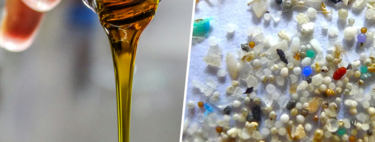
Ecosystem Impact. Microplastics are found in virtually every environment. They infiltrate agricultural soils , lakes , and oceans . Since animals consume these particles, they can enter the food chain, ultimately reaching us. Studies show that microplastics also harbor harmful agents, compounding their threat to both ecosystems and human health.
The dilemma is clear: microplastics are everywhere, and eliminating them appears to be a complex challenge. However, there is a glimmer of hope. Research is underway to develop filters capable of reducing microplastic intake. Innovative concepts are emerging, aiming for effective solutions that protect both human health and the environment.